
Quick answer: Dental social media marketing services are not automatically the best fit for every practice. A small office with editing and approval capacity may need templates rather than an agency. A growing practice may need internal ownership, outside production, or a managed service. Compare total cost, remaining team work, clinical control, and exact deliverables.
This guide compares editable templates, an in-house employee, a freelancer, a dental social media marketing agency, and a hybrid workflow. It is for US and Canadian private practices seeking a realistic operating model—not promises that posting alone will generate patients or appointments.
Start With The Job Your Practice Needs Done
Searching for dental social media marketing services does not always mean a practice needs a full-service company. The real requirement may be one or more of the following:
- Planning a consistent monthly content schedule
- Creating branded feed, Story, Reel-cover, Facebook, or Pinterest graphics
- Writing captions and calls to action
- Collecting and approving clinic photography
- Publishing posts and monitoring comments or messages
- Promoting a new-patient, hygiene, whitening, implant, or seasonal campaign
- Managing paid social advertising
- Tracking phone calls, contact forms, consultation requests, or other agreed conversion events
- Maintaining patient privacy, advertising accuracy, and internal approval records
Write down the exact jobs before comparing providers. A template library can solve planning and production problems, but it does not publish posts, answer messages, run advertisements, or provide legal review. An agency may provide several of those services, but the practice still owns clinical accuracy, patient authorization, account access, and final approval.
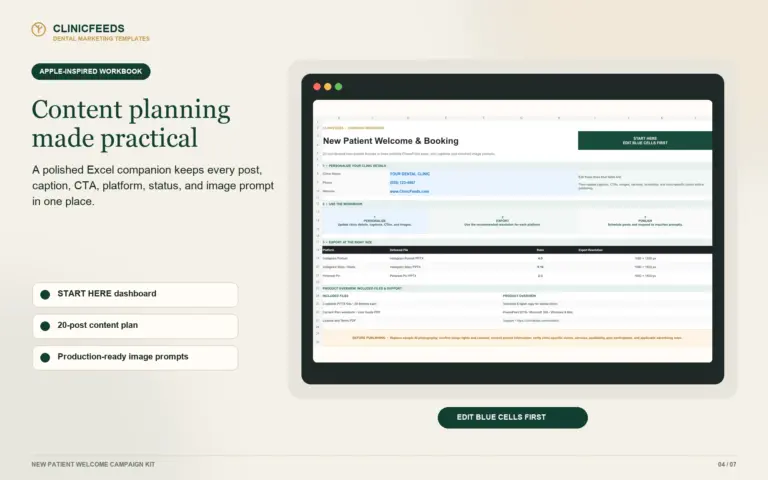
If your immediate need is a repeatable content workflow, begin with the dental social media marketing and content planning hub. Use the separate dental social media strategy framework to define goals, platform roles, approvals, and measurement before choosing a production model. If you are comparing purchasable resources, review the ClinicFeeds dental marketing kits.
Templates, In-House, Freelancer, Agency, Or Hybrid?
| Operating model | Best fit | Practice still owns | Main advantage | Main limitation |
|---|---|---|---|---|
| Editable template system | A small practice with an employee who can customize and publish content | Editing, approvals, scheduling, replies, reporting, photography, and compliance | Low dependency on an outside provider and strong control over brand details | Requires protected staff time and a reliable workflow |
| In-house employee | A practice with recurring marketing work beyond social posts | Training, supervision, tools, workload planning, clinical review, and continuity | Close knowledge of the team, services, schedule, and local patient questions | Social media can become a secondary task that loses priority during busy periods |
| Freelancer | A practice needing flexible design, writing, editing, or scheduling support | Briefing, account governance, clinical approval, privacy controls, and performance decisions | Flexible access to a specific skill without building a full internal role | Capacity, availability, dental knowledge, and backup coverage vary |
| Dental marketing agency | A practice needing coordinated strategy, production, publishing, reporting, or paid media | Business goals, access decisions, claim approval, patient authorization, and vendor oversight | Broader execution capacity and a defined service process | Higher commitment, more handoffs, and possible contract or account-access risks |
| Hybrid workflow | A practice that wants internal control with outside production or campaign support | Role clarity, final approval, shared calendar, account ownership, and measurement | Balances clinic knowledge with specialist capacity | Fails when responsibilities and turnaround times are not documented |
How To Calculate Dental Social Media Marketing Cost
Published price lists rarely show the complete dental social media marketing cost. Two proposals with the same fee may include very different work. Instead of relying on a generic price range, calculate the annual cost of each operating model with the same formula.
Agency Or Managed-Service Formula
Annual managed-service cost = onboarding and setup + (recurring service fee × contract periods) + paid-media spend + photography or video + extra design or copy + software + internal review time + revision time + account transition costs.
Do not count media spend as agency compensation unless the proposal defines it that way. Ask whether reporting, community monitoring, campaign landing pages, tracking setup, and creative revisions are included or billed separately.
Template-System Formula
Annual template-workflow cost = template licence + editing software + internal editing hours + image sourcing or photography + approval time + scheduling tools + reporting time + periodic content refreshes.
A template licence may have a low purchase price, but the workflow is not free. Someone must update the clinic name, contact information, services, offer details, imagery, colours, and calls to action. The clinic must also review every post before publication.
In-House Formula
Annual in-house cost = compensation and employment overhead + recruitment and training + software and equipment + photography or production support + management time + continuing education + coverage during leave or turnover.
If social media is assigned to an existing employee, calculate the opportunity cost of the hours removed from scheduling, patient communication, treatment coordination, or other responsibilities. “Existing staff” should not be entered as zero cost.
Freelancer Formula
Annual freelancer cost = project or recurring fees + briefing time + revisions + software or asset licences + scheduling support + backup coverage + internal approval and reporting time.
Calculate internal labour consistently across all options:
Internal labour cost = fully loaded hourly cost of each role × hours spent on planning, collecting assets, reviewing, revising, publishing, monitoring, and reporting.
This produces a practice-specific comparison without assuming one price range fits every market or clinic.
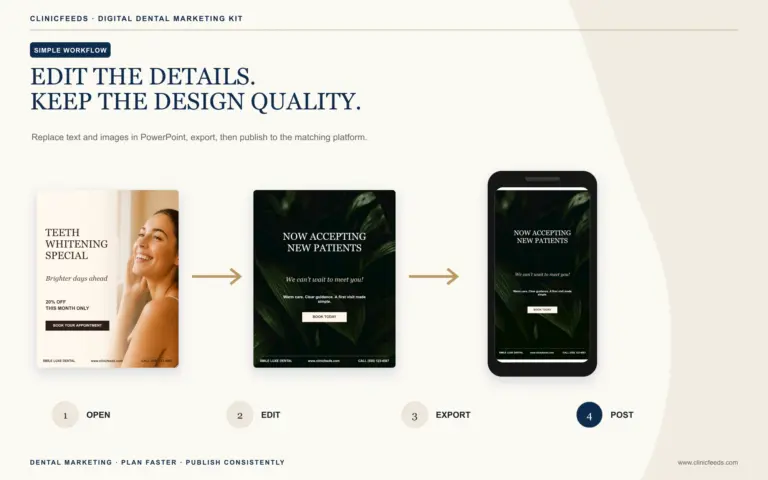
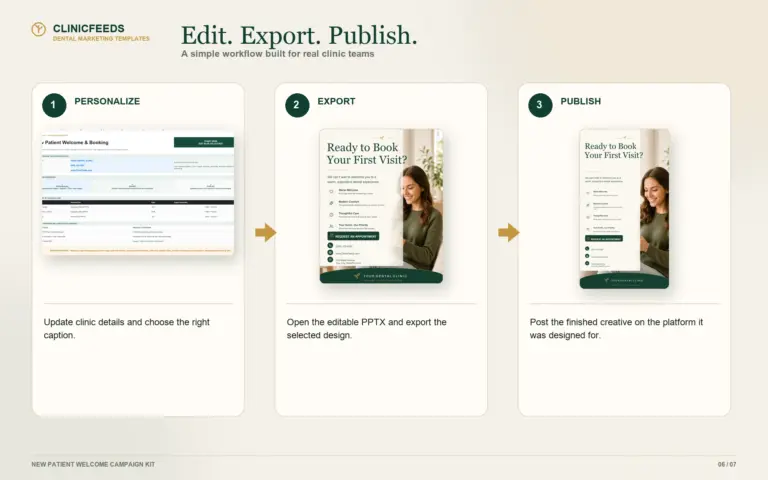
When the clinic chooses an internal or hybrid workflow, the PowerPoint template editing guide shows the actual customization steps, while the 90-day dental social media plan helps estimate the recurring production and approval workload.
Hidden Costs That Change The Decision
- Unclear scope: “Management” may mean design, scheduling, or a fuller service. Require an itemized scope covering platforms, formats, captions, revisions, approvals, reporting, responses, and paid media.
- Clinical revisions: A polished post is unusable if it describes the wrong service, offer, appointment type, or treatment claim. Count authorized clinical review time.
- Images and authorization: Clarify who obtains releases, stores proof, licenses assets, replaces demonstrations, and approves identifiable patient material.
- Account ownership: Confirm ownership of social pages, ad accounts, audiences, analytics, and source files. Prefer role-based access over shared passwords and document the exit handoff.
- Approval delays: Name the final approver, turnaround time, missed-deadline rule, and evergreen replacement process.
- Community management: Publishing is not monitoring. Assign comments, messages, reviews, spam, and transfer of patient-specific conversations to a secure clinic channel.
- Weak attribution: Define useful outcomes such as profile visits, tracked calls, forms, directions, or consultations. Avoid promises based only on likes, impressions, or incomplete attribution.
Which Model Fits Your Dental Practice?
Choose Templates When
Templates fit when a dependable employee can customize and publish content, the main problem is blank-page work or inconsistent planning, and the team can protect recurring time for review. They are not enough when the practice needs daily monitoring, paid-ad management, or outsourced reporting.
Choose An In-House Role When
An in-house role fits when marketing extends into email, website updates, events, local campaigns, or frequent original media. Management must be able to define priorities, protect the role from unrelated work, and evaluate results.
Choose A Freelancer When
A freelancer fits a defined design, writing, video, or scheduling need that does not justify a broader retained service. The practice still needs a clear brief, timely clinical approval, and backup coverage.
Choose A Dental Social Media Marketing Agency When
An agency fits when the practice needs coordinated strategy, production, publishing, analytics, or paid campaigns and internal capacity is consistently unavailable. Choose one only when its contract separates included work, optional work, and media spend, and the practice can assign an internal owner.
Choose A Hybrid Model When
A hybrid model fits when the clinic wants internal control but needs outside capacity—for example, an employee customizes templates while a freelancer handles video, or an agency runs paid campaigns while the clinic owns routine organic content.
Questions To Ask A Dental Social Media Marketing Company
Use the same questions with every freelancer, consultant, or agency so that proposals can be compared fairly.
- What is delivered? Specify platforms, formats, quantities, captions, revisions, publishing, monitoring, reports, and meetings.
- Who reviews clinical claims? Define responsibility for treatments, offers, health statements, and local advertising rules.
- What must the clinic supply? List photography, service details, access, approvals, and response handling.
- Who owns accounts and files? Cover editable files, ad accounts, audiences, analytics, and handoff.
- How is information protected? Ask about access, storage, subcontractors, secure channels, deletion, and incidents.
- How are images and testimonials approved? The practice should retain required permissions and substantiation.
- What costs extra? Check media, photography, video, assets, landing pages, revisions, and rush work.
- How are results and approvals handled? Define metrics, attribution limits, approvers, deadlines, and version history.
- What happens at exit? Confirm notice, files, account transfer, deletion, and continuing licence restrictions.
US And Canada Compliance Considerations
This section provides general operational information, not legal advice. Dental advertising, privacy, professional conduct, consent, and recordkeeping requirements differ by jurisdiction. A practice should consult its own legal and regulatory advisers.
United States
The American Dental Association’s marketing and advertising guidance warns that privacy obligations continue to apply on social media and that even revealing a person is a patient may create a privacy issue. Its social media policy guidance recommends appropriate written permission before posting patient photographs, testimonials, radiographs, names, or other identifying material.
The U.S. Department of Health and Human Services explains that HIPAA places controls on uses and disclosures of protected health information for marketing, subject to defined exceptions. Do not send patient details through ordinary social channels or assume that a public comment allows the practice to disclose information in reply.
The Federal Trade Commission states that advertising claims must be truthful, non-deceptive, and supported by appropriate evidence. Reviews, testimonials, before-and-after presentations, discounts, and compensated endorsements require particular care. State dental-board and consumer-protection requirements may add further obligations.
Canada
The Office of the Privacy Commissioner of Canada explains that the applicable privacy framework can depend on the type of organization, province, information involved, and whether information crosses borders. PIPEDA, provincial private-sector laws, and provincial health-information laws may apply in different combinations.
Provincial dental regulators can also impose professional advertising requirements. For example, the Royal College of Dental Surgeons of Ontario provides guidance on professional boundaries, patient privacy, online discussions, endorsements, and marketing. Canadian practices should check the rules of their own provincial regulator rather than treating one province’s guidance as national law.
For both countries, build a practical control process: use clinic-owned accounts, limit access, obtain appropriate permissions, remove unnecessary identifiers, verify every service and claim, document approval, and move patient-specific conversations to an authorized secure channel.
What ClinicFeeds Provides—And What It Does Not
ClinicFeeds sells downloadable, editable dental marketing templates and planning resources. It is not a dental social media marketing agency, managed service, posting platform, legal service, or clinical compliance reviewer.
The Dental Social Media Template Bundle is currently US$59 and combines reusable PowerPoint templates, Excel planning resources, and PDF guidance from three included dental content kits. It is licensed for one dental practice location. The clinic edits its own details, replaces demonstration images where appropriate, reviews the content, exports the finished graphics, and publishes them through its chosen channels. Check the product page for the current file list, included campaigns, software requirements, and licence terms before purchasing.
The bundle can reduce blank-page work for a practice choosing a template-led or hybrid workflow. It does not include social account management, custom strategy, photography, video production, posting, comment monitoring, advertising, analytics management, or guaranteed business results.
A Simple Buying Decision
- List the recurring jobs. Separate planning, production, approval, publishing, monitoring, paid media, and reporting.
- Measure available internal time. Confirm who can perform each job and how many protected hours they have.
- Calculate total cost. Use the same annual formula for templates, in-house work, freelancers, agencies, and hybrid options.
- Check risk and control. Review account ownership, access, consent, clinical approval, claim verification, and exit terms.
- Choose the smallest model that completes the required job. Do not buy a full service when the problem is only content production; do not buy templates when the practice has no capacity to customize and publish them.
- Review after one operating cycle. Compare completed posts, approval time, missed deadlines, staff burden, enquiries, and content quality—not only follower growth.
Frequently Asked Questions
What Do Dental Social Media Marketing Services Usually Include?
There is no universal scope. Services may include strategy, graphic design, captions, video editing, publishing, community monitoring, reporting, paid advertising, or only part of that list. Request an itemized statement of work and identify what the dental practice must supply and approve.
How Much Does Dental Social Media Marketing Cost?
The useful figure is the total operating cost for your required scope, not a generic market average. Add provider or licence fees, media spend, production extras, software, internal labour, approvals, revisions, photography, reporting, and transition costs. Compare every option with the same annual formula.
Is A Dental Social Media Marketing Agency Better Than Templates?
Neither option is inherently better. An agency may fit a practice that needs broader execution and has limited internal capacity. Templates may fit a practice with an employee who can customize, approve, and publish content. A hybrid model can combine reusable templates with outside specialist support.
Can Templates Replace A Social Media Manager?
No. Templates provide a production starting point. They do not set clinic strategy, collect permissions, verify services and claims, schedule posts, answer messages, manage paid advertising, or interpret performance data unless the practice assigns people to those tasks.
Does ClinicFeeds Provide Dental Social Media Marketing Services?
No. ClinicFeeds sells downloadable dental templates and planning resources. It does not provide agency services, social media management, SaaS software, custom posting, or paid-ad management.
Can One ClinicFeeds Purchase Be Used For Several Locations?
No. The current licence is for one dental practice location. A separate purchase is required for each additional clinic location. Review the current ClinicFeeds licence terms and refund and digital delivery policy before purchase and use.
Will Social Media Templates Generate More Appointments?
No product or service can responsibly guarantee that result. Templates can make content production more organized and consistent. Outcomes also depend on the clinic’s offer, local demand, reputation, patient experience, targeting, follow-up process, website, response speed, and measurement.
Sources And Further Guidance
- American Dental Association: Marketing and Advertising
- American Dental Association: Social Media Policies for Dentists
- U.S. Department of Health and Human Services: HIPAA Marketing Guidance
- Federal Trade Commission: Advertising and Marketing Guidance
- Office of the Privacy Commissioner of Canada: Summary of Privacy Laws
- Royal College of Dental Surgeons of Ontario: Use of Social Media
Last reviewed: August 5, 2026. Recheck provider scope, product details, and the rules that apply to the practice before making a purchasing or publishing decision.
Considering a template-led or hybrid workflow? Review the exact contents, software requirements, one-location licence, and current US$59 price of the ClinicFeeds Dental Social Media Template Bundle before deciding whether it fits your team’s available time and responsibilities.