
Quick answer: A dental social media approval checklist is a pre-publish record that assigns responsibility for clinical accuracy, patient authorization, image rights, offer details, contact information, and final sign-off. Move every post through four visible statuses—Draft, Reviewed, Approved, and Published—and do not schedule it until the required reviewer has approved the exact copy and image being used.
This checklist is designed for private dental practices, practice managers, front-desk or marketing coordinators, and agencies working on behalf of a dental clinic. It helps a team make its review process repeatable; it does not determine whether a post complies with every law, professional standard, contract, or platform rule that may apply.
Important: This article provides general operational information, not legal, privacy, clinical, employment, or regulatory advice. Requirements vary by jurisdiction and by the facts of the post. Ask the practice’s qualified legal, privacy, insurance, and professional advisers to review its policy and authorization forms.
What Should a Dental Social Media Approval Checklist Cover?
Before a dental post is published, the practice should be able to answer six questions:
- Who wrote and edited the post?
- Who checked the clinical statements?
- Does the practice have the permissions needed for every identifiable person and every visual asset?
- Are the result, price, offer, and testimonial claims accurate and supportable?
- Does the final file work on the intended platform and lead to the correct appointment path?
- Who gave final approval, and where is that decision recorded?
A spelling check is useful, but it is not an approval system. The goal is to review the exact post a patient will see: final image or video, final caption, disclosures, hashtags, link, offer terms, and scheduled date.
Assign Four Responsibilities Before Content Is Created
A small practice does not need four employees for this process. One person may hold more than one role, but each responsibility should still be completed and recorded as a separate step.
| Responsibility | What the person checks | What should be recorded |
|---|---|---|
| Content coordinator | Brief, platform, copy, spelling, image source, clinic details, CTA, link, size, and proposed publish date | Draft owner, content ID, source files, and draft date |
| Clinical reviewer | Treatment descriptions, health statements, terminology, limitations, and whether the post could create an inaccurate expectation | Reviewer name or initials, review date, and required corrections |
| Privacy and permissions reviewer | Patient authorization, employee or contractor permission, image licence, testimonial permission, and whether confidential information appears anywhere in the file | Authorization or licence reference—not unnecessary patient details in a shared marketing sheet |
| Final approver and publisher | The corrected final version, offer terms, disclosures, destination link, publication account, and timing | Approval date, final filename, scheduled date, and live URL |
The American Dental Association recommends designating someone to monitor practice social media while the practice maintains final approval of posts. Its guidance also says employees should not speak for the practice unless they are authorized to do so. A written workflow prevents an enthusiastic team member, freelancer, or agency from publishing on behalf of the clinic without a defined review step.
If your team struggles to assign production time as well as review responsibility, use the workflow in How to Run Dental Social Media Without Filming Staff before adding more content.
Use Four Content Statuses: Draft, Reviewed, Approved, Published
Draft
The copy and visual are still being assembled. Nothing in Draft is ready to schedule, even if the layout looks finished.
Reviewed
The assigned clinical and permissions checks have been completed. If a reviewer requests a material change—such as changing a treatment statement, patient image, price, or offer—the revised post should return to Reviewed status.
Approved
The final approver has signed off on the exact version intended for publication. Editing the caption or replacing the image after this point invalidates the approval and sends the post back for review.
Published
The post is live, its URL and publication date are recorded, and any expiry or archive date has been added. Time-sensitive promotions should not remain live indefinitely without review.
Dental Social Media Approval Checklist: 12 Checks Before Publishing
1. Confirm the purpose, audience, and platform
- Write one purpose for the post: educate, welcome, remind, build trust, or present an offer.
- Identify the intended audience without using a patient list or other personal information unless the practice has confirmed a permitted use.
- Name the publication account and platform before designing the file.
- Make sure the CTA matches the purpose. An educational post does not always need a promotional claim.
Pass only if: The reviewer can explain what the post is meant to help a prospective or current patient understand or do.
2. Review every clinical and treatment statement
- Confirm service names, indications, limitations, timeframes, and aftercare statements with an appropriately qualified reviewer.
- Remove absolute language such as “painless,” “permanent,” “risk-free,” “guaranteed,” or “works for everyone” unless the practice has a lawful, supportable reason to use it.
- Distinguish general education from diagnosis or individualized treatment advice.
- Check whether a visual, headline, or omitted limitation creates an implied claim that the caption does not state directly.
- Verify any number, percentage, comparison, or “clinically proven” statement against the evidence on which the practice intends to rely.
In the United States, the Federal Trade Commission says advertising claims must be truthful, non-deceptive, and supported by evidence. The FTC considers the overall impression of an ad, including express and implied claims conveyed through both words and images.
Pass only if: The clinical reviewer approves the exact wording and visual impression—not just the general topic.
3. Check patient identity, authorization, and privacy
- Look beyond faces. Names, voices, appointment screens, charts, radiographs, distinctive tattoos, treatment details, room conversations, and metadata may identify a person.
- Confirm that any required authorization covers the specific information, purpose, channel, and period of use.
- Do not assume that consent to treatment, a general photography release, or permission to post on the clinic website automatically covers social media marketing.
- Confirm who signed when the patient is a minor or cannot provide the required authorization.
- Store the authorization securely and reference it in the marketing log without copying unnecessary health information into that log.
For U.S. practices subject to HIPAA, the Department of Health and Human Services explains that using or disclosing protected health information for marketing generally requires a valid written authorization, subject to limited exceptions. HHS also states that allowing media into treatment areas where protected health information is accessible requires prior authorization from affected individuals; blurring or pixelating someone later is not a substitute for preventing the unauthorized access in the first place.
Pass only if: The designated privacy reviewer can locate the appropriate permission and confirm that the proposed post fits its scope.
4. Review testimonials, reviews, and before-and-after content separately
- Confirm permission to identify the patient and publish the testimonial or images.
- Confirm that the testimonial reflects the person’s genuine experience and has not been edited to change its meaning.
- Do not use a testimonial to make a treatment claim the practice could not support if it made the claim directly.
- Disclose an incentive or other material connection clearly when it could affect how a viewer evaluates the endorsement.
- Check that before-and-after images are the same person and are not altered to exaggerate the outcome.
- Use comparable framing, lighting, scale, and presentation where practical, and include relevant context needed to avoid a misleading impression.
- Do not assume that adding “results vary” corrects an otherwise misleading image or promise.
The FTC’s Endorsement Guides apply to social media as well as other advertising. They emphasize truthful endorsements, support for the claims an endorsement communicates, and clear disclosure of material connections. Separate rules may govern dental testimonials or before-and-after advertising in a state, province, or professional jurisdiction.
Pass only if: Both the permission to use the content and the advertising claim communicated by it have been reviewed.
5. Verify rights for photos, illustrations, logos, music, and staff images
- Record whether an asset is clinic-owned, patient-authorized, employee-authorized, properly licensed, or supplied under a valid contract.
- Check the licence for commercial social media use, modification, attribution, client use, and expiration restrictions.
- Obtain the appropriate permission before using identifiable employees, contractors, or visitors; employment alone should not be treated as automatic marketing consent.
- Check music and video licences for the business account and intended platform.
- Do not present stock or AI-generated people as actual patients or as documented treatment outcomes.
- Check third-party trademarks, product packaging, professional logos, and certification marks before use.
Pass only if: The practice can identify the source and permitted use of every asset in the post.
6. Verify offers, prices, dates, and eligibility
- Confirm the exact service, stated price, currency, inclusions, exclusions, and applicable location.
- Add the start and end dates, or remove time-sensitive language if there is no active promotion.
- Explain important eligibility restrictions or conditions where needed to prevent a misleading impression.
- Check “free,” “save,” “starting at,” financing, insurance, membership, and limited-availability wording with the appropriate adviser.
- Make sure the landing page, front-desk script, and scheduling team use the same offer details.
Pass only if: A caller could receive the offer described without discovering a material condition that the post omitted.
7. Add disclosures where viewers will actually notice them
- Place required qualifications or material-connection disclosures close to the claim or endorsement.
- Use plain language and readable type rather than hiding a disclosure in a hashtag block or linked page.
- Check that Story, Reel, or feed crops do not cut off the disclosure.
- Do not rely solely on a platform’s built-in disclosure tool if the applicable guidance requires more.
Pass only if: A typical viewer can see, read, and understand the disclosure before acting on the claim.
8. Test the phone number, link, and appointment CTA
- Call the phone number displayed in the visual and caption.
- Open the booking or information link on a mobile device.
- Confirm that the destination page describes the same service or offer.
- Check the clinic name, address, location, hours, and provider details.
- Do not promise a clickable caption link on a platform placement that does not support one; give a clear alternative such as the profile link or call button.
Pass only if: A prospective patient can complete the next step without guessing where to go.
9. Inspect the correct platform file
Review the final export—not only the editable source file. Common working sizes include:
- 4:5 feed: 1080 × 1350 px
- 9:16 Story or Reel: 1080 × 1920 px
- 2:3 Pinterest Pin: 1000 × 1500 px
Check that the post has not been stretched, cropped incorrectly, or exported at low resolution. Keep essential text away from interface overlays and preview the Story or Reel file on a phone. For more detail, use the Dental Social Media Post Sizes guide.
Pass only if: The final file is sharp, readable, correctly proportioned, and safe from platform cropping.
10. Proofread for clarity and accessibility
- Read the headline, visual text, caption, hashtags, and CTA as one message.
- Use plain language and explain unfamiliar dental terminology.
- Check colour contrast and text size on a real mobile screen.
- Add useful alternative text where the platform supports it.
- Add captions or a transcript to video where appropriate.
- Remove unexplained placeholders, sample clinic information, and demonstration claims.
Pass only if: The post can be understood without relying on tiny text, colour alone, or background knowledge.
11. Confirm scheduling and monitoring
- Check the publication date against holidays, clinic closures, offer dates, and appointment availability.
- Confirm which account will publish the post and who has access to it.
- Assign someone to monitor comments and direct messages.
- Decide how clinical questions, complaints, emergencies, and requests involving personal information will be moved to an appropriate private channel.
- Set an archive or re-review date for promotions and time-sensitive claims.
Pass only if: The practice knows who will respond after publication as well as who will press Publish.
12. Record final approval without storing unnecessary patient information
The approval log should make the decision auditable without becoming a duplicate patient record. Record:
- Content ID and final filename
- Topic, platform, size, and intended audience
- Caption or copy version
- Asset source and licence reference
- Patient authorization reference, where applicable
- Clinical reviewer and review date
- Final approver and approval date
- Scheduled date, live URL, and archive or expiry date
Follow the practice’s approved retention and access policy. Do not place diagnoses, chart numbers, full authorization forms, or other unnecessary health information in a broadly shared marketing planner.
Pass only if: The practice can identify which exact version was approved and who approved it.
Copy-and-Use Final Sign-Off Record
| Field | Record before publishing |
|---|---|
| Content ID | Unique internal name or number |
| Final filename | Approved export, including size or platform |
| Status | Draft / Reviewed / Approved / Published |
| Clinical review | Reviewer initials and date |
| Privacy and permissions | Reviewer initials, authorization or asset reference, and date |
| Offer check | Price, conditions, location, start date, and end date confirmed |
| CTA test | Phone number or destination URL tested |
| Final approval | Authorized approver initials and date |
| Publication record | Account, scheduled date, live URL, and archive date |
United States: What Should the Approval Process Account For?
A U.S. dental practice should first determine which federal and state requirements apply to it. Do not assume that this article, a sample release, or a software checkbox answers that question.
- HIPAA and patient information: HHS explains that covered entities generally need an individual’s valid written authorization to use or disclose protected health information for marketing, subject to limited exceptions. The authorization must satisfy the applicable requirements; informal permission is not automatically equivalent.
- Filming and photography: HHS says providers cannot allow media into treatment or other areas where protected health information will be accessible without prior authorization from affected individuals. Blurring an identity later does not cure unauthorized access during filming.
- Practice governance: ADA guidance recommends written social media policies, appropriate written permissions for identifiable patients and others, a designated monitor, and final practice approval.
- Claims and testimonials: FTC standards require advertising to be truthful and supported. A testimonial cannot be used to communicate a claim the advertiser could not support directly, and material connections should be disclosed clearly.
- State and professional rules: State dental boards, consumer-protection laws, privacy laws, employment laws, payer agreements, and professional standards may add requirements.
A useful operational rule is to separate three questions: “May we use this person’s information?”, “Is the claim accurate and supportable?”, and “Does our professional regulator permit this presentation?” Passing one question does not answer the other two.
Canada: Why the Checklist Must Be Adapted by Province
There is no single “Canadian dental social media consent form” that can safely be assumed to work for every practice and every post. The Office of the Privacy Commissioner of Canada explains that PIPEDA applies in some settings, while substantially similar provincial private-sector or health-information laws may apply in others. More than one law can apply, including when information moves across provincial or national borders.
- Meaningful consent: OPC guidance says people should understand the nature, purpose, and consequences of the collection, use, or disclosure of personal information. The form of consent depends on sensitivity and reasonable expectations; express consent is generally expected for sensitive information or uses outside those expectations.
- Purpose and platform matter: A permission for one use should not automatically be treated as permission for every channel or every treatment detail.
- Provincial professional standards matter: The relevant dental college may regulate advertising, professional boundaries, patient privacy, titles, testimonials, or presentation of treatment outcomes.
- Ontario example: The Royal College of Dental Surgeons of Ontario warns that professional obligations extend online. Its examples show why consent for patient photos on a clinic website should not be treated as consent to disclose additional treatment information or distribute the images on another social platform.
Before publishing, a Canadian clinic should identify its province, applicable privacy regulator, dental college, type of personal information, intended platform, and whether an outside agency or service provider will receive the information. Do not copy a U.S. HIPAA authorization and assume it satisfies Canadian requirements.
How to Use Editable Templates Without Skipping Approval
Templates reduce design and planning time; they do not approve clinical claims, supply patient permission, verify an offer, or make a post legally compliant. Treat every template as a Draft until the clinic has completed its own review.
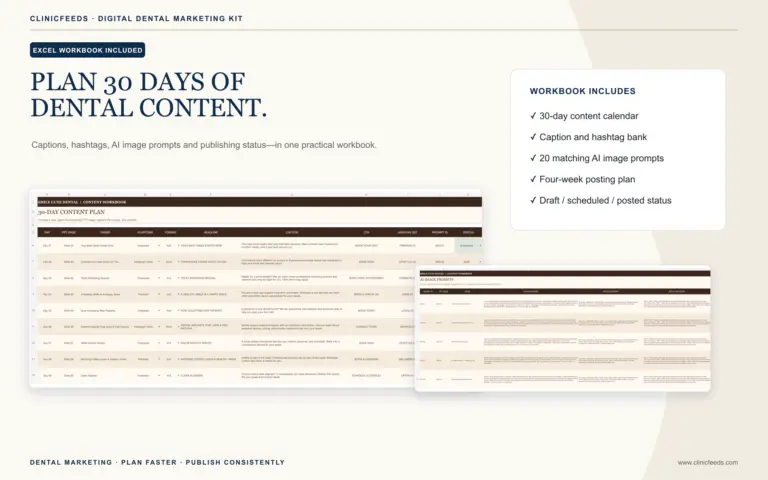
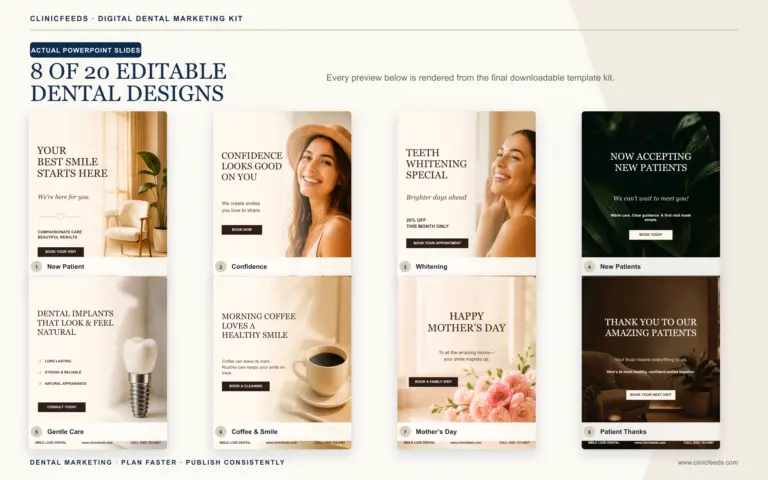
The ClinicFeeds Dental Social Media Template Bundle contains 60 content themes across everyday dental content, new-patient communication, and hygiene and gum-health education. Each theme is composed in 4:5, 9:16, and 2:3 formats, creating 180 editable PowerPoint pages, with three Excel planning workbooks and supporting PDF guides.
A practical workflow is:
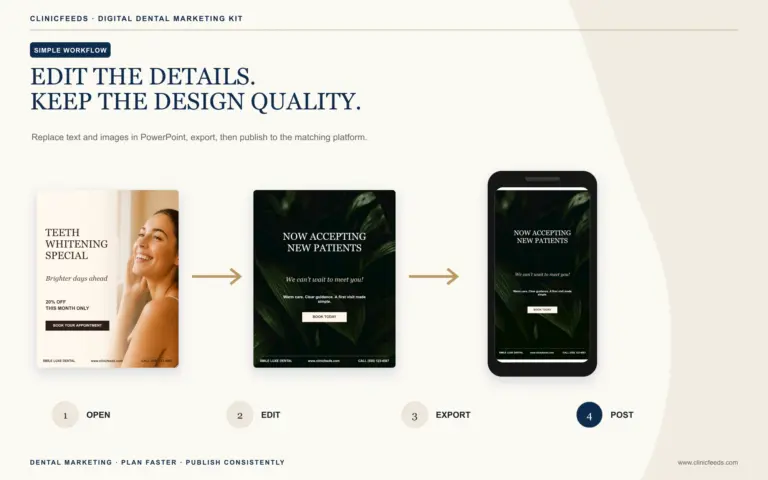
- Select the topic and platform in the relevant Excel planner.
- Open the matching PowerPoint size.
- Replace demonstration photography with clinic-owned, appropriately authorized, or properly licensed imagery.
- Customize the copy, service details, offer, location, phone number, and CTA.
- Move the post through Draft, Reviewed, and Approved before export and scheduling.
- Record the live URL and publication date after posting.
Use the PowerPoint customization guide for the editing workflow and review the ClinicFeeds License Terms before using the source files. One Bundle purchase is licensed to one clinic location. The files are a production system, not legal or clinical approval.
Frequently Asked Questions
Does a dental practice need written consent before posting a patient testimonial or photo?
Often, specific written authorization or consent will be required, but the exact document and legal standard depend on the jurisdiction, information, purpose, platform, and parties involved. ADA guidance tells dental practices not to post identifiable patient information, testimonials, photos, or radiographs without appropriate written permission. Have qualified advisers review the practice’s form and process.
Is blurring a patient’s face enough for a U.S. dental social media post?
Not necessarily. A person may be identifiable from other details. HHS also states that when media enter treatment areas where protected health information is accessible, blurring or pixelating identities afterward is not a substitute for obtaining the required authorization before access occurs.
Can a front-desk employee approve dental social media posts?
A practice can assign operational responsibilities to trained staff, but it should define who may approve clinical statements, privacy and permissions, and final publication. ADA guidance recommends that the practice maintain final approval even when an employee manages the account. Employment and professional rules should also be considered.
Do editable dental templates make a post compliant?
No. Templates can standardize size, layout, and production. The dental practice remains responsible for reviewing clinical accuracy, permissions, claims, offers, licensing, accessibility, and applicable laws and professional standards before publishing.
Should a post be reviewed again after a small edit?
Review again when an edit could change the clinical meaning, patient information, visual claim, price, offer, disclosure, destination link, or audience interpretation. The safest operational rule is that any material change after approval returns the post to Reviewed status.
How often should a dental practice update its approval checklist?
Review the workflow on a regular schedule and whenever the practice changes platforms, services, staff roles, outside agencies, authorization forms, or applicable rules. A yearly policy review is a practical minimum for many teams, but a qualified adviser may recommend a different schedule.
Official Sources and Further Reading
- American Dental Association: Social Media Policies for Dentists
- American Dental Association: Patient Privacy and Social Media
- U.S. Department of Health and Human Services: HIPAA and Marketing
- U.S. Department of Health and Human Services: Film and Media in Treatment Areas
- Federal Trade Commission: Advertising FAQs for Small Business
- Federal Trade Commission: Advertisement Endorsements
- Office of the Privacy Commissioner of Canada: Consent
- Office of the Privacy Commissioner of Canada: Provincial Laws That May Apply Instead of PIPEDA
- Royal College of Dental Surgeons of Ontario: Professional Use of Social Media
Last reviewed: August 4, 2026. Regulations and professional guidance can change; confirm current requirements in the jurisdiction where the practice operates.