This guide is written for private dental practices in the United States and Canada. Adapt terminology, privacy procedures, advertising claims and patient communication to the federal, state, provincial and professional rules that apply to your practice.
Quick answer
Strong dental patient education posts answer one common patient question at a time, use plain language, avoid diagnosing the reader, and point people back to the clinic for personalized guidance.
Good dental patient education posts explain one clear idea in plain language, avoid diagnosing the reader, and point people back to the clinic for personal guidance. The strongest posts answer common questions, reduce uncertainty, and help patients feel more prepared without making unsupported treatment claims or offering individualized clinical guidance online.
To connect education with local visibility, patient communication and appointment follow-through, place these topics inside a broader dental practice marketing plan rather than treating each post as a separate task.
What makes patient education content different
Patient education is not the same as promotion. A promotional post asks someone to consider a service or appointment. An educational post helps the reader understand a topic, process, or decision point. Dental practices need both, but they should not blur them so much that a helpful explanation becomes a result claim.
Patient education post ideas
Appointment education
- What to expect during a first visit.
- What information to bring to a new patient appointment.
- How a cleaning appointment is typically organized.
- When to call the office with a question before an appointment.
Preventive-care education
- Why regular preventive visits matter in general terms.
- How to make oral hygiene routines easier to remember.
- Common reasons patients delay care and how to ask questions early.
- General tips for preparing children for dental visits.
Cosmetic dentistry education
- Questions to ask before a whitening consultation.
- How to talk with the dentist about smile goals.
- Why individual suitability matters for cosmetic options.
- What a consultation can help clarify.
Trust and process education
- How the office communicates treatment options.
- How the team helps patients understand next steps.
- What the clinic does to make appointments feel organized.
- How patients can ask follow-up questions after a visit.
How to write clearly without giving clinical guidance
A simple rule is to educate at the category level and send personal decisions back to the provider. Instead of saying “you need this treatment,” write “a dentist can help determine whether this option fits your situation.” Instead of promising a result, explain what the appointment or consultation is designed to discuss.
Useful phrasing patterns
- “Ask your dental team if…”
- “A consultation can help clarify…”
- “Every patient is different, so your provider can explain…”
- “This post is general education, not a diagnosis.”
- “Contact the office for guidance specific to your appointment.”
Examples a clinic can adapt
- “Not sure what happens at a new patient visit? Here is a simple overview of what our team reviews.”
- “Thinking about whitening? A consultation helps determine which options may be appropriate for your smile goals.”
- “If you feel nervous about an appointment, tell the team. We can explain each step before we begin.”
- “A regular visit is a good time to ask questions about changes, sensitivity, or home-care routines.”
How to keep educational content patient-friendly
Patient education works best when it removes confusion. Avoid long clinical explanations unless the audience truly needs them. Use short headings, plain language, and a clear next step. A patient should understand whether the post is explaining an appointment, introducing a service conversation, or reminding them to contact the office with questions.
For a planning framework that connects education posts to the rest of the month, see how to build a 30-day dental content calendar.
Before-and-after and outcome-sensitive topics
Some dental content is more sensitive than a routine reminder. Cosmetic dentistry, whitening, orthodontic conversations, and smile transformation content need careful wording. If the practice uses before-and-after visuals, confirm consent, context, and local rules before publishing. If the practice does not want to manage that complexity, use education-led posts instead: process explanations, consultation questions, and expectation-setting content.
Review workflow for patient education posts
- Draft the post in plain language.
- Remove any statement that sounds like a personal diagnosis.
- Check whether the CTA sends personal questions back to the clinic.
- Confirm the topic matches services the practice actually offers.
- Have the appropriate team member review the content before scheduling.
Examples of safe educational angles
- “What to ask before a whitening consultation.”
- “How to prepare for a first dental visit.”
- “Why your dentist may recommend regular checkups based on your needs.”
- “How to talk with the team if dental visits make you nervous.”
- “What a consultation can help clarify before a cosmetic decision.”
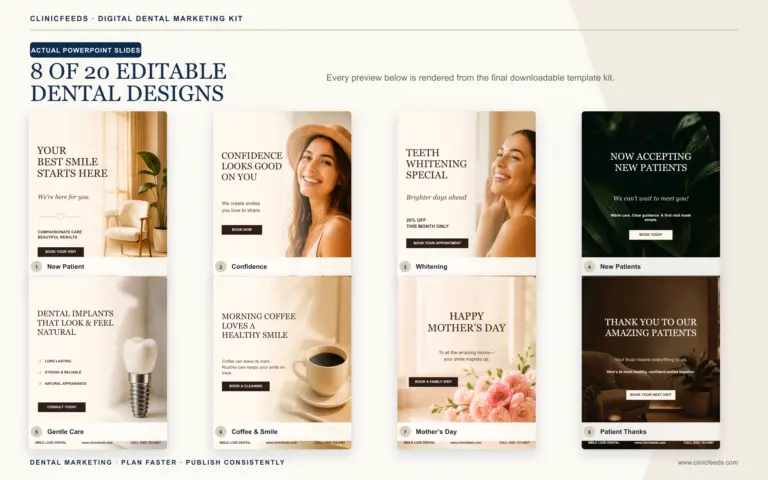
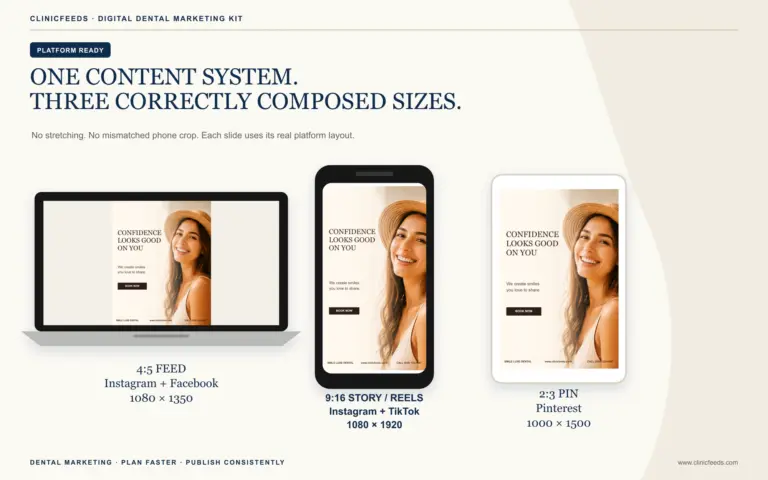
These angles help the patient understand the process while leaving individual recommendations to the provider. They also give the practice useful content that can be adapted into feed posts, Stories, short captions, or printed patient-education reminders.
How to turn one education topic into multiple posts
A single patient question can become several useful posts. For example, “What happens at a first visit?” can become a carousel, a short caption, a Story reminder, and a new patient checklist. The message stays consistent, but each format serves a different moment. This helps the clinic educate without needing a completely new idea every time.
- Carousel: outline the visit steps.
- Caption: answer one common concern.
- Story: remind new patients what to bring.
- Checklist: summarize preparation steps in a saveable format.
Editorial review questions
- Is the post general education rather than a personal recommendation?
- Does the post use plain language a patient can understand?
- Does the CTA send individual questions back to the clinic?
- Are patient privacy and image permissions protected?
- Would the post still feel accurate if read out of context?
If the answer to any question is uncertain, the post should be revised before publishing. That review step is especially important for cosmetic, restorative, or symptom-related topics.
Common mistakes to avoid
- Using diagnosis-style captions for a general audience.
- Suggesting one treatment is right for everyone.
- Making before/after promises.
- Using patient stories without proper permission.
- Turning educational posts into fear-based messaging.
- Using technical language patients are unlikely to understand.
Implementation checklist
- Choose one patient question.
- Write the answer in plain language.
- Remove any personalized diagnosis or result promise.
- Add a practical next step such as call, ask, or schedule a consultation.
- Have the post reviewed by the appropriate person before publishing.
For a broader content system, see 30 dental social media content ideas and how to build a 30-day dental content calendar.
You can also browse Dental Marketing Kits or explore Dental Social Media Templates.
Related reading
- 30 Dental Social Media Content Ideas
- What Should a Dentist Post on Instagram?
- Build a 30-Day Dental Content Calendar
Compliance note
This article is for marketing content planning only. Dental practices should review educational posts for clinical accuracy, patient privacy, consent, advertising requirements, and local professional rules before publishing.
Use the ready-made dental content system
If your clinic wants the planning structure, editable social templates, captions, and delivery files already organized, view the Smile Luxe Dental Social Media Template Kit or browse the Dental Social Media Content System.
Frequently asked questions
What makes a good dental patient education post?
A good dental patient education post explains one clear topic in plain language, sets expectations, avoids personalized diagnosis, and encourages patients to contact the clinic for individual guidance.
Can dental practices post treatment advice online?
Dental practices can share general educational information, but they should avoid diagnosing individuals or promising outcomes in social posts.
What patient education topics work well for dental social media?
Useful topics include hygiene reminders, appointment preparation, whitening questions, new patient expectations, preventive care, review requests, and common service explanations.
Sources And Review Notes
- American Dental Association: Social Media Checklist
- HHS: HIPAA Guidance on Marketing
- RCDSO: Use of Social Media
Last reviewed: July 23, 2026.