Quick Answer
A useful dental office phone script gives the front desk a repeatable path without forcing every conversation to sound identical. Start with a warm introduction, identify the caller’s main need, collect only the information required for the next step, explain appointment options accurately and close by restating what will happen. The scripts below cover common new patient situations for private dental practices.
These examples are for dental practice owners, office managers, reception teams and treatment coordinators in the United States and Canada. They are operational templates, not clinical, legal or insurance advice.
The Five-Part New Patient Call Structure
- Welcome: identify the practice and yourself.
- Reason for calling: invite the caller to explain what they need in their own words.
- Clarify the next step: ask only the scheduling and routing questions the practice has approved.
- Offer accurate options: explain availability, intake requirements and how benefit questions are handled.
- Close the loop: repeat the date, time, location and follow-up action.
The American Dental Association’s patient intake guidance emphasizes that the initial phone call shapes the patient’s first impression and that staff should follow consistent procedures for collecting information and explaining what happens next.
Core Dental Office Phone Script
Front desk: Thank you for calling [Practice Name]. This is [Name]. How may I help you today?
Caller explains.
Front desk: Thank you for explaining that. I can help with the next step. May I get your name, the best phone number to reach you and [only the other approved information needed]?
Front desk: Based on what you’ve told me, the next step is [accurate process]. I can review available appointment options, but the dentist will determine appropriate care after an assessment.
Front desk: I have [requested/confirmed] [date and time] at our [location]. You will receive [forms/confirmation] by [channel]. If anything changes, call us at [phone]. Is there one practical scheduling question I can answer before we finish?
Seven New Patient Call Mistakes That Cost The Practice Follow-Up
- Quoting insurance participation or coverage before verification. Record the plan information and explain the practice’s verification process instead of promising payment or eligibility.
- Making the caller repeat the same story. Capture the primary need once and pass a concise note to the correct team member.
- Describing a request or waitlist as a confirmed appointment. State clearly whether a time is booked, pending review or unavailable.
- Promising treatment, comfort or results before assessment. The phone call can explain the next step, not diagnose the caller or guarantee an outcome.
- Collecting unnecessary sensitive information in an unapproved channel. Follow the practice’s privacy and secure-communication process.
- Ending without a specific owner and deadline. Every unresolved call needs a named callback owner and expected response window.
- Failing to record the outcome. Close the call as a confirmed appointment, request awaiting review, callback with an owner and deadline, or no booking with the documented reason.
A script improves conversion only when the next owner and follow-up time are visible in the practice system.
New Patient Phone Scripts By Situation
Caller Asks, “Are You Accepting New Patients?”
Yes, [Practice Name] is currently accepting new patients for [accurate scope, if needed]. I can ask a few scheduling questions and review the next available options. Are you looking for a routine first visit, or is there a concern you would like our team to route appropriately?
If the practice is using a waitlist, say that directly. Do not describe a waitlist form as a confirmed appointment.
Caller Wants The Earliest Appointment
I can review our current openings. Before I do, may I confirm whether you have a flexible schedule and whether you would like to be contacted if an earlier time becomes available? The appointment is not reserved until we confirm the specific time with you.
Caller Asks About Insurance
We can explain how our office handles benefit information and what details we need from you. Coverage and payment amounts depend on your plan and the care recommended, so we cannot guarantee benefits over the phone. If you share [approved information] through [approved process], our team can review the administrative next step.
Caller Asks For A Price Before Assessment
I understand that cost is important. Fees depend on the service and the dentist’s assessment. I can provide [a consultation fee / an approved general fee range / the office’s payment information], but I do not want to give you an inaccurate treatment estimate before the clinical team has the information it needs.
Caller Mentions Pain Or An Urgent Concern
I’m sorry you are dealing with that. I need to follow our office’s urgent-call process so the appropriate team member can review the next step. If you believe this is a medical emergency, call emergency services. May I collect [approved routing details]?
The front desk should not diagnose the caller. The practice needs a documented triage and escalation policy approved by its clinical leadership.
Caller Is Nervous About Dental Visits
Thank you for telling me. Many people have questions about what to expect. I can note your concern using our approved process and explain the practical steps for the first visit. The clinical team can then discuss appropriate options with you after learning more.
Parent Calls For A Child
I can help with the scheduling process. May I confirm the child’s age and the reason for the requested visit using the information our office requires? I will also explain the forms, guardian information and arrival instructions for the appointment.
Caller Was Referred By Another Provider
Welcome to [Practice Name]. I can check whether the referral information has been received and explain the next step. A referral does not automatically reserve an appointment, so our team will confirm the appropriate booking process with you.
No Suitable Time Is Available
The times we reviewed do not match your schedule today. I can [add your approved preferences to our short-notice list / suggest the next available period / arrange a call back]. A waitlist request does not guarantee that an earlier appointment will open.
Closing A Confirmed Booking
Let me repeat the details: your appointment is on [date] at [time] at [address]. Please [verified preparation step]. We will send a confirmation to [approved channel]. If you need to make a change, contact us at [phone] by [policy timing].
Closing An Unconfirmed Request
We have recorded your request, but no appointment is confirmed yet. [Name or team] will contact you by [realistic timeframe] to review availability. If you do not hear from us by then, call [phone].
Missed Call And Voicemail Scripts
Outbound Missed-Call Message
Hello, this is [Name] calling from [Practice Name] for [First Name]. Please return our call at [phone] during [hours]. We are following up on your request to contact the office. For privacy, we have not included additional details in this message.
Practice Voicemail Greeting
You have reached [Practice Name]. Our office is [closed/helping other patients]. Please leave your name, phone number and a brief request. Do not leave detailed health information. If this is a medical emergency, call emergency services. We return routine calls during [hours/timeframe].
Questions The Front Desk Should Not Improvise
- Clinical diagnosis or whether a specific treatment is appropriate.
- Guaranteed insurance coverage or exact patient cost before the required verification and assessment.
- Guaranteed treatment results.
- Advice for a potentially urgent medical situation outside the approved escalation protocol.
- Disclosure of patient information to a caller whose identity and authority have not been handled under office policy.
How To Train The Team Without Sounding Scripted
- Train the decision path, not just the sentences. Staff should know which questions lead to scheduling, escalation or a call back.
- Use approved phrases for high-risk topics. Insurance, cost, urgency and privacy need consistent boundaries.
- Role-play realistic interruptions. Include callers who are rushed, unsure, upset or asking several questions at once.
- Document the outcome. Record the request, commitment and next owner in the practice system.
- Review a small sample. Look for missed follow-up, inaccurate promises and friction—not a robotic word-for-word performance.
US And Canada Practice Notes
Use the practice’s approved privacy and identity-verification procedures. In the United States, a phone conversation can involve protected health information subject to HIPAA safeguards. In Canada, privacy requirements can include federal and provincial rules. Professional regulators may also set communication standards.
A script should never override clinical judgment, emergency protocols or the practice’s legal obligations. Review it with the dentist owner, practice manager and appropriate adviser before rollout.
Connect The Call To The Rest Of The Patient Journey
After the call, send a concise message that repeats the confirmed next step. Use these dental new patient welcome messages and appointment reminder templates to keep the language consistent.
Align the front-desk wording with the 2–4 week new patient dental social media campaign plan so the public message, first call and follow-up step do not contradict one another.
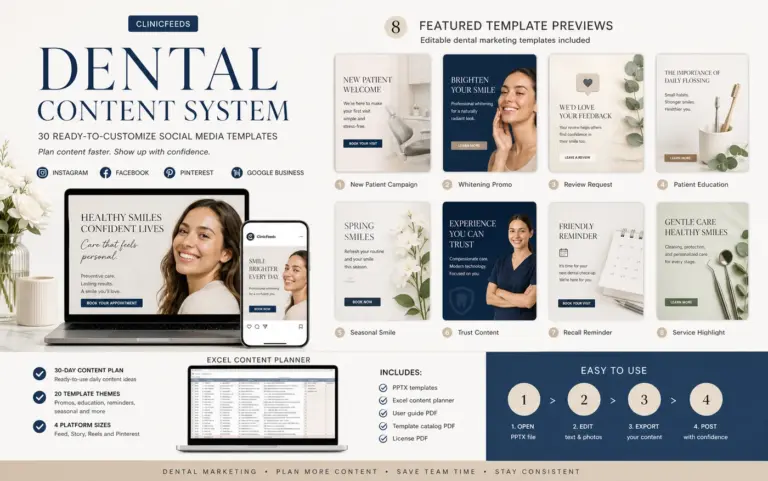
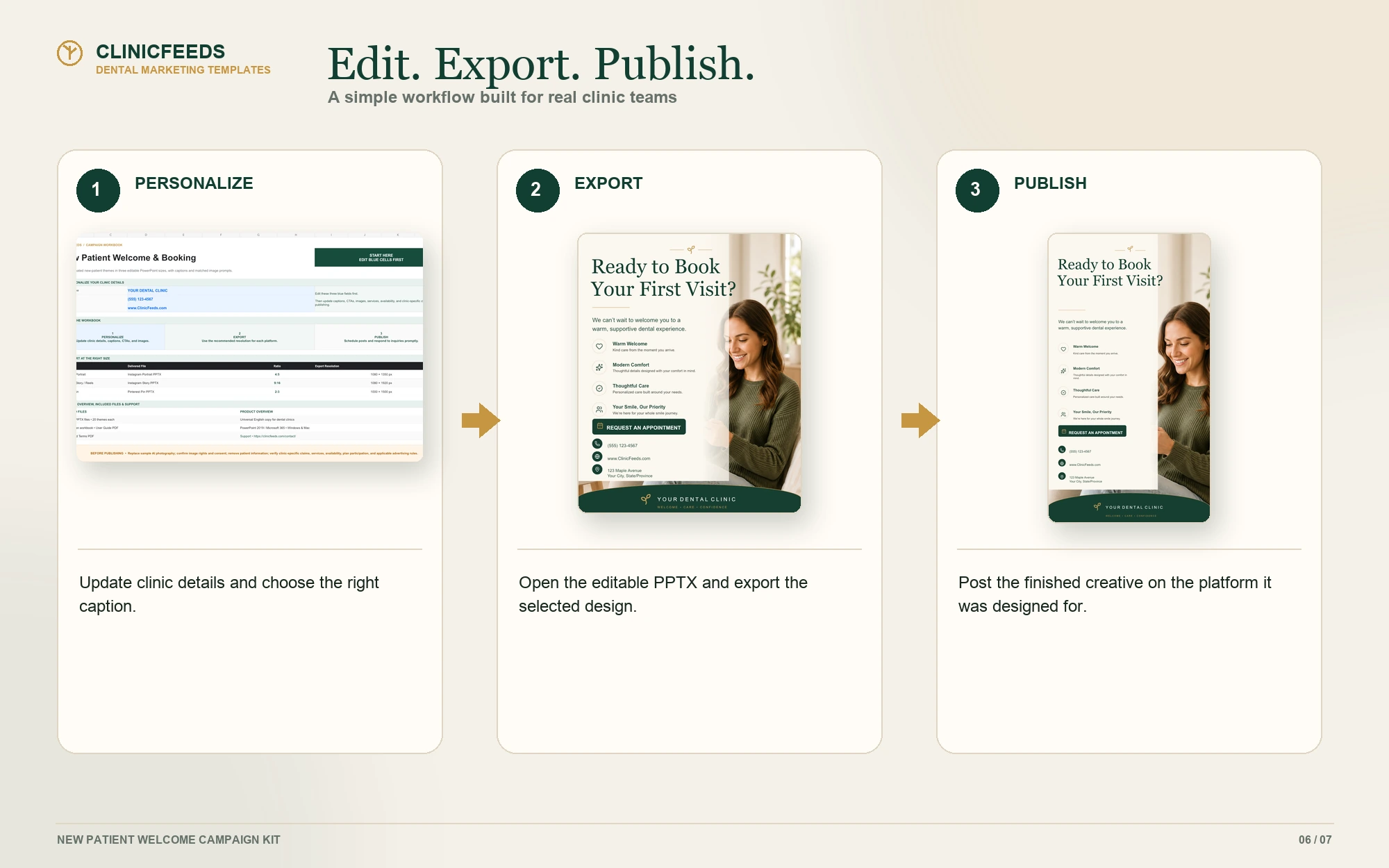
The New Patient Welcome Campaign Kit supports the broader journey with editable posts about the team, first visits, common questions and appointment preparation. It is a content resource—not a phone, scheduling or patient-management system.
Frequently Asked Questions
Should A Dental Receptionist Follow A Script Word For Word?
No. Use the script as a decision guide and source of approved language. The conversation should remain natural while required information and boundaries stay consistent.
What Information Should Be Collected On The First Call?
Collect only the contact, scheduling and routing information required by the practice’s approved intake process. Sensitive details should move through the appropriate secure workflow.
How Should Staff Answer Insurance Questions?
Explain the office process and avoid guaranteeing coverage or final cost. Benefits depend on the plan, eligibility, submitted information and recommended care.
What If A Caller Describes An Emergency?
Follow the practice’s clinical escalation protocol immediately. Front desk staff should not diagnose or rely on a general marketing script for urgent situations.
How Can A Practice Measure Whether The Script Works?
Track whether inquiries receive follow-up, whether booking details are accurate, the reasons calls do not convert and the questions that repeatedly create confusion. Use the findings to improve the workflow.
Sources And Review Notes
Last reviewed: August 4, 2026.