
Quick answer: A dental social media marketing strategy is the set of decisions that determines why a practice publishes, which patients it needs to help, what role each platform plays, who reviews the content, where each call to action leads, and how the team will judge whether the work is useful. The strategy comes before the content calendar. A calendar schedules posts; a strategy explains what those posts are meant to accomplish.
For most private practices, the strongest strategy is not “post every day.” It is a manageable system tied to one business priority, a defined patient audience, a small number of repeatable content pillars, and a clear path from a useful post to the next appropriate step. That step may be reading a service page, calling the office, requesting an appointment, or saving information for later. The ClinicFeeds dental social media marketing hub organizes the related planning guides, platform resources, and available template kits.
This guide is for dental owners, practice managers, front-office leads, and in-house marketing coordinators in the United States and Canada. It provides a decision framework, not legal advice, clinical guidance, a guarantee of inquiries, or a done-for-you marketing service.
Strategy Is Different From A Posting Plan
A posting plan answers operational questions: what will publish next Tuesday, which image is needed, and when approval is due. Strategy answers the decisions behind that plan. If the practice has not agreed on the audience, priority, platform role, approval owner, and destination for each call to action, a full calendar can still produce scattered content.
Use this article to make the decisions. Then use the 90-day dental social media content plan to turn those decisions into a 12-week production schedule.
The Eight Decisions Every Dental Social Media Strategy Needs
| Decision | Question To Resolve | Useful Output |
|---|---|---|
| Practice goal | What should social content support during this period? | One primary objective |
| Patient audience | Whose question or hesitation are we addressing? | One or two priority patient situations |
| Platform role | Why are we using Instagram, Facebook, or Pinterest? | A job for each active channel |
| Content pillars | Which recurring subjects serve the objective? | Three to five repeatable themes |
| Governance | Who writes, checks, approves, and publishes? | Named owners and deadlines |
| Patient pathway | What should a person do after the post? | One appropriate CTA and destination |
| Measurement | Which signals would indicate useful progress? | A short monthly scorecard |
| Production model | Can the team execute internally, or does it need help? | Templates, staff, freelancer, or agency decision |
1. Choose One Primary Practice Goal
“Get more patients” is too broad to guide content. Start with a specific operational priority the practice can support. Examples include explaining the first-visit process to prospective patients, increasing awareness of hygiene and gum-health services, improving implant consultation readiness, or maintaining consistent everyday visibility.
The goal should match real capacity. A practice should not heavily promote a service if appointments are unavailable, the website does not explain it, the team cannot answer common questions, or the offer has not been checked. Social media cannot repair a broken booking path.
Write the objective in one sentence: “For the next review period, our content will help [audience] understand [service or decision] and take [next step].” This prevents unrelated ideas from taking over the calendar.
2. Define The Patient Situation, Not A Generic Persona
Dental practice social media marketing strategies work better when the audience is described by a real situation rather than a fictional profile. “Adults considering an implant but unsure what a consultation includes” is more useful than “women aged 35–55.” “Families who moved into the area and need to understand the first visit” gives the team practical questions to answer.
For each priority audience, list:
- the question they are likely to ask before contacting the office;
- the uncertainty that may delay action;
- the information the practice can truthfully provide;
- the next step the practice can realistically support.
Do not infer a person’s diagnosis, treatment need, insurance status, or eligibility from a comment or follow. Public content should educate generally; individual recommendations belong in an appropriate clinical conversation.
3. Give Each Platform A Clear Role
Using dental social media for marketing does not mean publishing identical material everywhere. One underlying topic can be adapted, but the composition, context, and destination should fit the channel.
| Platform | Best Strategic Role | Practical Format |
|---|---|---|
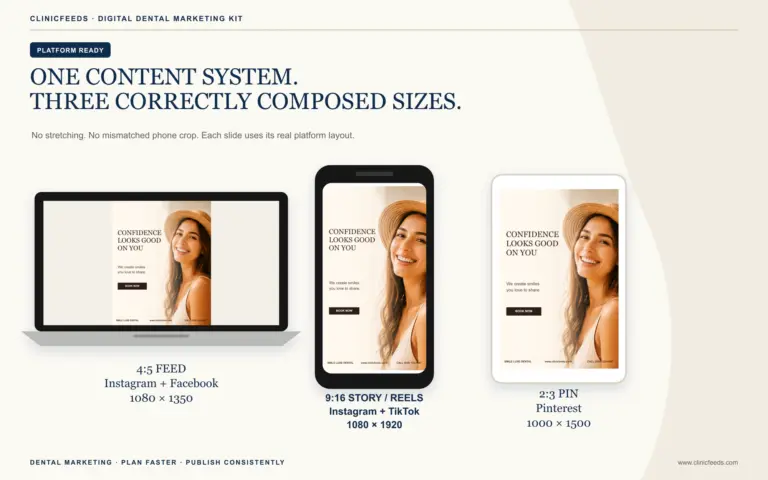
| Instagram Feed | Build a recognizable visual library of education, services, and practice trust | 4:5 portrait post |
| Instagram Stories or Reels | Support timely reminders, short sequences, and day-to-day visibility | 9:16 vertical asset |
| Reach local patients with clear explanations, updates, and shareable practice information | Readable portrait post with contextual copy | |
| Create searchable, saveable educational resources that can lead to a useful website page | 2:3 vertical pin | |
| Google Business Profile | Keep local practice information and selected updates current | Concise update linked to an accurate destination |
Use only the platforms the team can maintain. The dental social media post-size guide explains why resizing one design is not always enough.
4. Build Content Pillars Around Patient Decisions
Three to five pillars are usually enough. A private practice might choose patient education, first-visit expectations, hygiene and prevention, treatment consultation questions, and trust-building practice information. Each pillar should connect to the primary goal without repeating the same promotional message.
A useful mix includes:
- Education: plain-language explanations and common questions;
- Process clarity: what happens before, during, or after an appointment;
- Trust: team roles, office standards, and authentic patient feedback used appropriately;
- Service awareness: accurate descriptions of services the practice actually provides;
- Action: reminders or invitations connected to a clear next step.
For a larger bank of subjects, use the dental social media content ideas guide. The strategy determines which ideas belong in the plan; the list itself is not the strategy.
5. Assign Ownership And Approval Before Production
Consistency often fails at approval, not design. Define the smallest workable workflow:
- Content owner: selects the topic and prepares the draft.
- Facts owner: checks services, fees, availability, clinical language, and local details.
- Privacy and brand reviewer: confirms image permission, identifiers, tone, and required disclosures.
- Final approver: accepts the complete post.
- Publisher: schedules the approved version and verifies the link.
Record who can approve routine education and what must be escalated to a dentist or practice owner. Set a deadline and define what happens when approval is late. The dental social media approval checklist provides a repeatable pre-publish review.
6. Design A Patient Pathway, Not Just A CTA
“Book now” is not appropriate for every post. Match the call to action to the reader’s stage and the page they will see next.
- An educational post may lead to a detailed service page or invite the reader to save the information.
- A first-visit post may link to new-patient information, forms, or contact options.
- A consultation post may direct qualified readers to a page that explains what the consultation includes.
- A timely practice update may ask patients to call the office for current availability.
Check the full route on a phone: post, profile, link, landing page, form or phone number, and front-desk response. Do not ask people to disclose symptoms, treatment history, or other sensitive information in public comments or unsecured direct messages.
7. Measure Signals That Match The Goal
Follower count alone does not show whether the strategy supports the practice. Use a small scorecard tied to the selected objective.
| Signal | What It May Indicate | Important Limitation |
|---|---|---|
| Saves and shares | The information was useful enough to keep or pass along | They do not equal an appointment |
| Profile and website visits | The post created interest in the practice | Confirm links and analytics are working |
| Calls, forms, or consultation requests | People reached a conversion point | Ask how the person found the practice |
| Front-desk questions | Content may be shaping patient conversations | Use a simple shared log instead of memory |
| Production time and approval delays | The system is or is not sustainable | Efficiency is not the same as marketing effectiveness |
Review patterns, not one post. Record the topic, platform, CTA, destination, and meaningful response. Change one variable at a time when possible. No template, posting frequency, or platform can guarantee reach, inquiries, or appointments.
8. Choose The Right Production Model
| Model | Best Fit | Practice Still Owns |
|---|---|---|
| Editable templates plus internal staff | A practice with a coordinator who can customize and publish | Accuracy, approvals, photos, responses, and results |
| Freelancer | A practice that needs production help but can direct and review the work | Briefing, clinical accuracy, access control, and final approval |
| Agency or marketing service | A practice that needs broader strategy, publishing, reporting, or paid-media support | Vendor oversight, privacy, claims, access, and patient experience |
| Dedicated in-house marketer | A larger practice or group with enough workload for ongoing ownership | Goals, governance, resources, and clinical sign-off |
ClinicFeeds sells downloadable, editable content products. It is not a social media management agency, publishing platform, ad-buying service, or guarantee of business results. A template system can reduce blank-page design work, but the practice must still customize, approve, publish, respond, and measure.
If the practice is deciding between internal templates and outside help, use the dental social media services vs templates comparison to evaluate cost, scope, internal workload, account control, and practice fit.
A Practical Strategy-Building Sequence
- Audit current profiles, links, recent posts, website destinations, and team capacity.
- Select one primary practice objective and one or two patient situations.
- Assign a role to each platform the practice will actively maintain.
- Choose three to five content pillars that support the objective.
- Define the CTA and destination for each pillar.
- Name the content owner, reviewer, approver, and publisher.
- Create a scorecard that includes both patient-response and production signals.
- Select the production model, then build the calendar.
Once these decisions are documented, move to the dental social media content calendar guide or the separate 90-day execution plan. This keeps strategic choices stable while individual topics and dates change.
US And Canada Review Requirements
Rules vary by jurisdiction and by the facts of a post. In the United States, review HIPAA requirements before using or disclosing protected health information, including identifiable patient images or stories. HHS explains that uses or disclosures of PHI for marketing generally require a valid authorization, subject to specific definitions and exceptions. ADA guidance also emphasizes that dental advertising should not be false or materially misleading or create unjustified expectations.
In Canada, privacy and professional advertising requirements can involve federal, provincial, and territorial rules. The Office of the Privacy Commissioner of Canada explains that meaningful consent is central to PIPEDA where it applies. Each practice should also consult its provincial dental regulator; Ontario’s RCDSO, for example, treats material published by or for a dental office as professional advertising and requires dentists to understand the applicable responsibilities.
Before publishing, verify patient authorization, remove unintended identifiers, substantiate objective claims, describe services and fees accurately, disclose material connections where required, and avoid guaranteed or universal treatment outcomes. Replace sample images with clinic-owned, patient-authorized, or properly licensed photography. Obtain advice from qualified privacy, legal, and regulatory professionals for the practice’s circumstances.
Turn The Strategy Into Editable Content
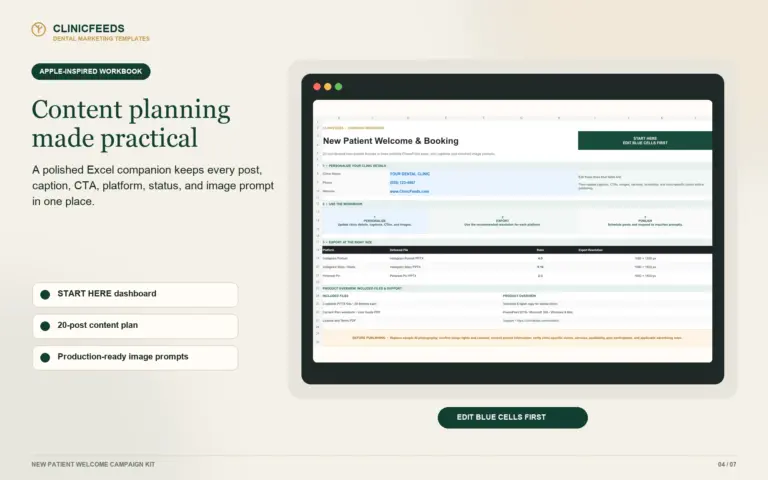
The Dental Social Media Template Bundle is a US$59 digital library for one licensed dental practice location. It combines Smile Luxe everyday content, New Patient Welcome content, and Dental Hygiene & Gum Health content: 60 themes composed in 4:5, 9:16, and 2:3 formats, creating 180 editable PowerPoint pages in total. It also includes three Excel content workbooks and PDF guides.
The bundle does not include the Dental Implant Consultation Campaign Kit, automated scheduling, account management, custom strategy, or agency services. Review the product page for the exact file list, software requirements, license terms, and delivery details before purchasing.
Review The US$59 Dental Social Media Template Bundle
Frequently Asked Questions
What Is A Dental Social Media Marketing Strategy?
It is a documented set of decisions about the practice goal, patient audience, platform roles, content pillars, approval process, patient pathway, measurement, and production model. It guides the calendar but is not the calendar itself.
How Often Should A Dental Practice Post?
There is no universal frequency. Choose a cadence the team can produce, review, and maintain without sacrificing accuracy. Strategy should determine what deserves publication; capacity should determine the sustainable frequency.
Should A Dentist Use Every Social Platform?
No. Use platforms that match the audience, content format, and team capacity. A well-maintained Instagram and Facebook presence may be more useful than five neglected accounts. Pinterest can add value when the practice has evergreen educational pages worth saving and visiting.
Can Templates Replace A Dental Marketing Agency?
No. Templates can reduce design and planning work for an internal team. They do not provide custom research, account management, publishing, community response, paid advertising, analytics configuration, or professional legal and compliance review.
Who Should Approve Dental Social Media Posts?
The practice should name an owner with authority to confirm clinical language, services, offers, privacy, image permissions, and brand fit. Posts involving treatment claims, patient information, testimonials, fees, or jurisdiction-specific requirements may need additional review.
How Should A Practice Measure Social Media?
Use metrics connected to the chosen objective: useful engagement such as saves, visits to relevant pages, attributable calls or forms, consultation requests, front-desk feedback, and the time required to produce and approve content. Avoid treating followers or impressions as proof of revenue.
Sources And Review Information
- American Dental Association: Marketing and Advertising
- U.S. Department of Health and Human Services: HIPAA Marketing Guidance
- Federal Trade Commission: Advertisement Endorsements
- Office of the Privacy Commissioner of Canada: PIPEDA Consent
- Royal College of Dental Surgeons of Ontario: Advertising Guidelines
Last reviewed: August 5, 2026. Regulatory links and product details should be checked again before future substantive updates.