
A post can reach thousands of people and still leave the appointment book unchanged. That does not automatically mean the creative failed. Reach, interest, website action, appointment request, booking and attendance are different stages—and a break at any one of them can make the campaign look ineffective.
Quick Answer
If dental social media produces likes but few appointment requests, inspect the path after the post. The content should answer one patient question, the CTA should describe one relevant next step, and the destination should continue the same message. Track calls and forms separately from reach and clicks.
Likes are not appointment intent
In one public marketing discussion, a dental campaign generated substantial reach, comments and hundreds of link clicks but only a few online bookings. The useful lesson is not that social media never works. It is that engagement and patient acquisition require different measurements.
A person may like a team photo because they recognize the hygienist. They may save an education post because it is useful. Neither action means they need a dentist today.
Social content can build familiarity and reduce uncertainty, but the practice still needs a route for the smaller group that is ready to take action.
Gap 1: the post has no single job
A common dental post tries to educate, promote a service, introduce the team, announce an offer and request an appointment at the same time. The reader cannot tell what matters.
Give each post one job:
- Explain the first-visit process.
- Answer one common hygiene question.
- Introduce professional whitening as a consultation topic.
- Show how to contact the office after hours.
- Remind existing patients how to request an appointment.
The post becomes easier to understand and easier to measure.
Gap 2: the CTA is generic
“Contact us today” places all the work on the reader. A stronger CTA names what happens next.
New-patient content
- See what to expect at your first visit.
- Review what to bring to a new-patient appointment.
- View the practice's current appointment-request options.
Service-awareness content
- Learn what a whitening consultation may include.
- Read the practice's general information about dental implants.
- Ask the team which appointment type is appropriate for your question.
Hygiene education
- Save this reminder for your next visit.
- Read what happens during a preventive appointment.
- Contact the office if you need help scheduling your next visit.
The CTA should not imply a diagnosis, guarantee a result or promise availability the practice cannot deliver.
Gap 3: the destination does not match the post
If a new-patient post sends everyone to a generic homepage, the reader must search again for:
- Whether the practice is accepting patients
- What the first visit includes
- How to request an appointment
- Where the practice is located
- Which questions require a phone call
Send the reader to the closest matching page.
| Social topic | Best destination |
|---|---|
| First-visit explainer | New-patient or first-visit page |
| Whitening consultation | Whitening service or consultation information |
| Gum-health education | Relevant patient-education page |
| Holiday hours | Contact or location page |
| Appointment availability | Appointment-request page |
The headline, image and first sentence on the destination should make it obvious that the reader arrived in the right place.
Gap 4: the practice stops tracking at the click
A simple measurement chain is enough:
- Post reach or impressions
- Saves, shares or meaningful engagement
- Profile activity
- Website visit, call or message
- Appointment request
- Appointment booked
- Appointment attended
Use a tagged URL for campaign links when practical. Record the lead source in the practice's existing process, and give the front desk one consistent question such as, “How did you hear about the practice?” Do not collect unnecessary health information through public comments or unsecured social messages.
A seven-day conversion audit
Day 1: review the last ten posts
Write down the job of each post. If a post has three or four competing goals, mark it for revision.
Day 2: test every link on a phone
Confirm that it loads, matches the post, shows the next step and does not hide the contact or appointment option.
Day 3: rewrite the CTAs
Replace vague buttons or caption endings with a specific next step.
Day 4: check the response route
Decide who responds to messages, when they respond and which questions must move to a private, appropriate channel.
Day 5: create one new-patient sequence
Publish a post that answers one first-visit question, links to the matching information and offers a clear appointment-request route.
Day 6: verify the front-desk handoff
Make sure the team knows which campaign is live, what it says and where inquiries may arrive.
Day 7: record the baseline
Document current profile actions, site visits, calls, forms and appointment requests. Compare the next four weeks against the baseline instead of judging the campaign from likes alone.
Match the product CTA to the reader's problem
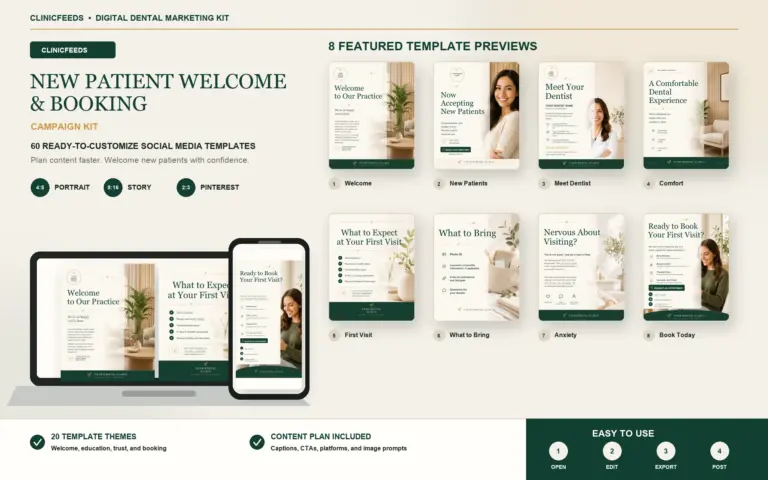
A general education article should not abruptly sell a cosmetic campaign. This article is about converting first-visit interest, so the most relevant product is the New Patient Welcome Campaign Kit.
It includes 60 editable PowerPoint pages across 20 new-patient themes, three platform sizes and an Excel campaign plan with captions, CTAs and image prompts. The campaign themes cover what to expect, what to bring, team introductions, appointment options and booking prompts. The practice must still replace its details and sample images and verify every service, availability statement and claim.
Related guidance:
- New patient dental Instagram captions
- Dental office new-patient phone script
- Dental appointment reminder messages
Frequently asked questions
Why does dental social media get engagement but no patients?
Engagement may come from existing patients, employees, peers or people who are not currently looking for care. Appointment requests require relevant intent, a clear next step, a matching destination and a responsive practice workflow.
What is a good CTA for a dental social media post?
The best CTA depends on the post. Examples include “See what to expect at your first visit,” “Read about the consultation process,” “Save this reminder,” and “Request an appointment.” Avoid using the same CTA on every post.
Should a dental practice track likes?
Likes can help compare creative themes, but they should not be the only business measure. Track profile activity, website visits, calls, forms, booked appointments and attended appointments where the practice can do so appropriately.
Should every dental post ask people to book?
No. Education and trust content can prepare people for a later decision. Use a booking CTA when the topic and reader intent support it.
Can social media guarantee new dental patients?
No. Content, audience, local demand, service availability, website experience, front-desk response and many other factors affect results. Avoid vendors or campaigns that guarantee a specific clinical or business outcome without a defensible basis.
Sources and review notes
- Reddit: Dental campaign reach, clicks and bookings discussion
- Reddit: Toronto dental practice social media and agency discussion
- American Dental Association: Marketing and Advertising
- Google Business Profile: Create and Manage Posts
This article provides marketing guidance, not a promise of patient acquisition. Practices should follow applicable privacy, advertising and professional requirements.
Last reviewed: July 27, 2026.