
Quick Answer
A useful dental implant social media campaign plan connects 14 posts into a patient journey rather than publishing 14 unrelated promotions. Begin with missing-tooth awareness and consultation education, answer common planning questions, then direct interested readers to the practice’s approved consultation route. Assign every post a purpose, destination, reviewer and response owner before publishing.
This guide is for dental practice owners, office managers, treatment coordinators and in-house marketers in the United States and Canada. It supports organic content planning; it is not a complete Google Ads, paid advertising, lead-generation or CRM strategy and does not replace clinical, privacy or legal review.
If your team needs standalone topics, start with these dental implant social media post ideas. For ready-to-adapt copy, use the dental implant Instagram captions. When clinical questions are delaying production, build the sequence from these dental implant patient education topics and assign each topic to an appropriate reviewer before design begins.
What This 14-Post Dental Implant Campaign Is Designed to Do
A person who has lived with a missing tooth for months or years may not be ready to book after seeing one “schedule today” graphic. They may first want to understand what an implant is, whether other options exist, what happens at a consultation, how long treatment may take, and which questions to ask.
The campaign therefore has four practical jobs:
- Create relevance. Help the right reader recognize that the post concerns a decision they are already considering.
- Reduce uncertainty. Explain the consultation and planning process without diagnosing anyone online.
- Support informed questions. Give prospective patients a reason to visit a service page, save a post or speak with the practice.
- Make the next step obvious. Direct high-intent readers to a consultation page, a practice phone number or a secure request form.
The sequence is educational by design. It should not promise candidacy, a specific timeline, a painless procedure, a permanent result or a guaranteed outcome. Those decisions depend on an individual assessment.
Set Up the Campaign Before Publishing Post 1
Do not begin by opening Instagram. Begin with the destination and the office workflow. A well-designed post cannot rescue a broken booking path.
1. Choose one primary conversion
Use one primary action throughout the four weeks: for example, “Request an implant consultation” or “Call the practice to ask about an implant consultation.” Avoid switching between a newsletter, a general contact page, direct messages and several different forms. A consistent action is easier for patients to understand and easier for the practice to measure.
2. Prepare a useful consultation landing page
The page linked from the campaign should answer the questions a prospective patient needs before making contact. At minimum, include:
- what the consultation is intended to evaluate;
- what usually happens during the visit at your practice;
- which records or information the patient may be asked to bring;
- the practice location, contact details and actual booking process;
- how fees, insurance questions or financing enquiries are handled, if applicable;
- a clear statement that suitability and treatment recommendations require an individual clinical assessment.
Use the practice’s real process. Do not copy a generic promise such as “same-day implants” unless the service is genuinely available and the claim has been reviewed for the circumstances in which it applies.
3. Assign four operational roles
One person may hold more than one role in a small office, but the responsibilities should still be explicit:
- Campaign owner: maintains the calendar, links and publishing status.
- Copy and design owner: adapts the post, caption and platform size.
- Clinical reviewer: checks descriptions of candidacy, treatment, healing, risks and timelines.
- Final publisher: confirms consent, links, dates, offers and approved wording before posting.
The American Dental Association recommends designated monitoring and final approval for practice social accounts. That is a useful operational standard even when a practice manager prepares most of the content.
4. Create a simple tracking convention
Add campaign parameters to the landing-page link rather than guessing where enquiries originated. A practical convention is:
?utm_source=instagram
Change the source and content value for each platform and post. Keep the names readable. The practice can then compare visits, form starts and completed requests without collecting clinical details in a public comment or direct message.
The 14-Post Dental Implant Consultation Campaign
Publish three or four times per week for four weeks. The spacing gives the team time to answer routine comments and lets a prospective patient encounter several parts of the story without seeing the same call to action every day. Adapt the exact days to the practice’s normal publishing rhythm.
Week 1: Make the Topic Relevant
Post 1 — Missing a Tooth? Start With the Decision, Not the Procedure
- Purpose: awareness
- Core message: a missing-tooth conversation begins with the person’s health, goals and available options—not with a universal recommendation.
- CTA: “Learn what an implant consultation can help evaluate.”
- Destination: consultation landing page
- Owner / approval: marketing owner drafts; dentist reviews the description of options.
Use a neutral visual such as a clinician discussing a model with an adult patient. Avoid imagery that implies every missing tooth should be replaced with an implant.
Post 2 — What Is a Dental Implant?
- Purpose: basic education
- Core message: explain the implant, restoration and supporting structures in plain language, while noting that treatment plans vary.
- CTA: “Save this overview, then bring your questions to a consultation.”
- Destination: educational section of the implant service page
- Owner / approval: content owner drafts; clinical reviewer verifies terminology and illustration labels.
Keep the post focused. A single graphic should not attempt to explain every surgical and restorative stage.
Post 3 — Bridge, Denture or Implant?
- Purpose: option awareness
- Core message: different replacement approaches may suit different clinical circumstances, preferences and budgets.
- CTA: “See which questions can help you compare options.”
- Destination: an options-comparison page or a relevant section on the consultation page
- Owner / approval: dentist provides comparison points; marketing owner removes jargon.
Do not declare one option “best” for everyone. If the practice publishes a comparison, include meaningful limitations rather than comparing only the preferred service’s advantages.
Post 4 — What Happens at an Implant Consultation?
- Purpose: reduce booking uncertainty
- Core message: describe the practice’s actual consultation workflow: discussion, examination, records or imaging where appropriate, review of options and next steps.
- CTA: “Review what to expect before you request a visit.”
- Destination: consultation landing page
- Owner / approval: treatment coordinator supplies the workflow; clinician confirms the clinical steps.
This is often the first high-intent post. Make sure the landing page and front-desk script describe the same process.
Week 2: Explain How Planning Works
Post 5 — Why Records and Imaging May Be Part of Planning
- Purpose: explain the evaluation process
- Core message: a clinician may use an examination and appropriate records or imaging to understand anatomy and plan next steps.
- CTA: “Ask what information our team may need for your consultation.”
- Destination: consultation FAQ
- Owner / approval: clinician writes or closely reviews; publisher checks that no patient record appears without authorization.
Use a licensed illustration or a staged, non-identifiable scene. A radiograph is not automatically safe to publish simply because a name has been cropped; other details may still identify the patient.
Post 6 — Who May Be Considered for Dental Implants?
- Purpose: address candidacy questions without screening online
- Core message: suitability depends on individual oral and general health, anatomy, goals and a clinician’s assessment.
- CTA: “A consultation is the appropriate place to discuss your circumstances.”
- Destination: candidacy section on the service page
- Owner / approval: clinical reviewer owns this post; marketing edits only for clarity.
Avoid quizzes that tell a follower “you qualify.” A social post can identify questions, not determine a treatment recommendation.
Post 7 — Why Bone Support Matters
- Purpose: introduce a common planning consideration
- Core message: available bone and surrounding tissues are among the factors a clinician evaluates; additional procedures may or may not be recommended.
- CTA: “Bring your questions about bone support to an individual assessment.”
- Destination: consultation FAQ or educational article
- Owner / approval: clinician approves all wording and images.
Do not turn this into a diagnosis-by-caption. Avoid statements such as “If you have been missing a tooth for six months, you will need a graft.”
Week 3: Answer Timing, Recovery and Care Questions
Post 8 — The Treatment Journey Is Usually a Series of Steps
- Purpose: set realistic process expectations
- Core message: consultation, planning, treatment, healing and restoration may occur in separate stages; the sequence depends on the individual plan.
- CTA: “View the questions to ask about your proposed timeline.”
- Destination: treatment-journey section
- Owner / approval: treatment coordinator drafts a generic workflow; clinician checks that it is not presented as universal.
Avoid a fixed “start to finish” number unless the practice can explain the conditions behind it. A range can still mislead if important variables are omitted.
Post 9 — How Long Does Implant Treatment Take?
- Purpose: answer a high-intent question
- Core message: timing varies with the treatment plan, healing and any preparatory care; the consultation can provide a more relevant estimate.
- CTA: “Request a consultation to discuss a plan based on your needs.”
- Destination: consultation request page
- Owner / approval: clinical reviewer owns the answer; front desk confirms the booking wording.
Post 10 — What Should Patients Ask About Recovery?
- Purpose: prepare useful questions
- Core message: encourage patients to ask about post-treatment instructions, work or activity planning, follow-up and who to contact with concerns.
- CTA: “Save this question list for your consultation.”
- Destination: consultation-question checklist
- Owner / approval: clinical team provides questions; marketing formats them.
Do not give patient-specific recovery instructions in the comments. Move clinical questions to the practice’s approved communication and care process.
Post 11 — Caring for an Implant-Supported Restoration
- Purpose: communicate ongoing responsibility
- Core message: ongoing home care and professional follow-up remain important; instructions depend on the restoration and patient.
- CTA: “Ask how maintenance is planned for the option being discussed.”
- Destination: care and maintenance section
- Owner / approval: hygienist or dentist supplies practice-approved guidance; clinician gives final approval.
This post adds balance to the campaign. It shows that the practice is not presenting treatment as a maintenance-free purchase.
Week 4: Help the Reader Prepare and Act
Post 12 — Questions About Fees, Coverage and Payment
- Purpose: reduce administrative uncertainty
- Core message: explain how the practice discusses estimates, benefit verification or payment options—using only processes the office actually offers.
- CTA: “Contact our team for current practice-specific information.”
- Destination: fees or consultation information page
- Owner / approval: office manager verifies every administrative statement; clinician reviews any treatment-related qualification.
Do not imply that insurance will pay, that financing is guaranteed, or that a quoted starting price represents a complete treatment plan. If a promotion is included, publish clear terms where the offer appears and have the terms reviewed for local requirements.
Post 13 — Seven Questions to Bring to an Implant Consultation
- Purpose: support a more productive conversation
- Core message: suggest questions about alternatives, stages, individual risks and benefits, clinician experience, aftercare, costs and who to contact.
- CTA: “Save the list and bring it to your visit.”
- Destination: downloadable or on-page consultation checklist
- Owner / approval: treatment coordinator drafts; dentist confirms that the list supports informed discussion.
This post is a good candidate for saves and Pinterest traffic. Use a 2:3 checklist design for Pinterest and a 9:16 version for Stories, while keeping the complete list on an accessible web page.
Post 14 — Ready to Discuss Your Options?
- Purpose: direct consultation request
- Core message: invite the reader to speak with the practice about their questions and possible options, subject to individual assessment.
- CTA: “Request an implant consultation.”
- Destination: consultation request page
- Owner / approval: campaign owner confirms tracking link; office manager confirms availability; final publisher checks the full post.
Keep this final post direct but restrained. “Book a consultation” is clear. “Get your perfect permanent smile now” introduces claims the practice may not be able to support.
Four-Week Publishing Calendar
| Week | Suggested days | Posts | Primary stage |
|---|---|---|---|
| 1 | Monday, Wednesday, Friday, Sunday | 1–4 | Awareness and consultation familiarity |
| 2 | Tuesday, Thursday, Saturday | 5–7 | Evaluation and treatment planning |
| 3 | Monday, Wednesday, Friday, Sunday | 8–11 | Timing, recovery and maintenance |
| 4 | Tuesday, Thursday, Saturday | 12–14 | Preparation and consultation action |
This is a starting cadence, not an algorithmic rule. If the practice normally publishes twice a week, run the same sequence over seven weeks. Preserving the order matters more than compressing the calendar.
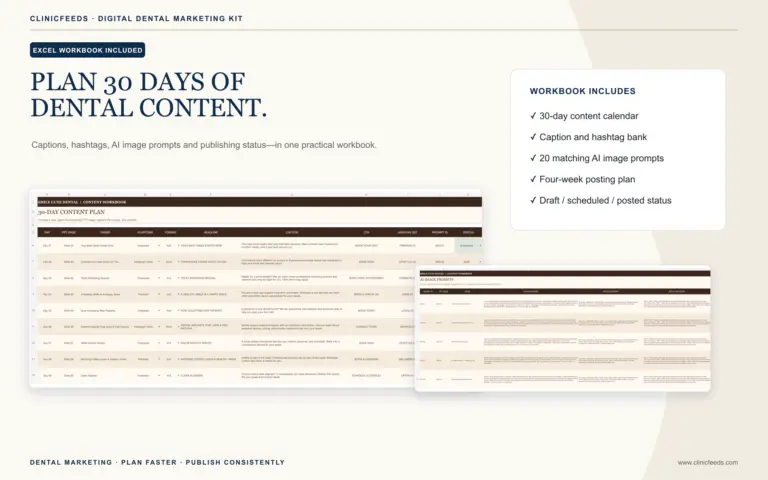
To manage preparation, approvals, links, Story and Pinterest reuse, replies and reporting around this patient-facing sequence, use the 30-day dental implant social media content calendar.
Adapt Each Post for Instagram, Stories and Pinterest
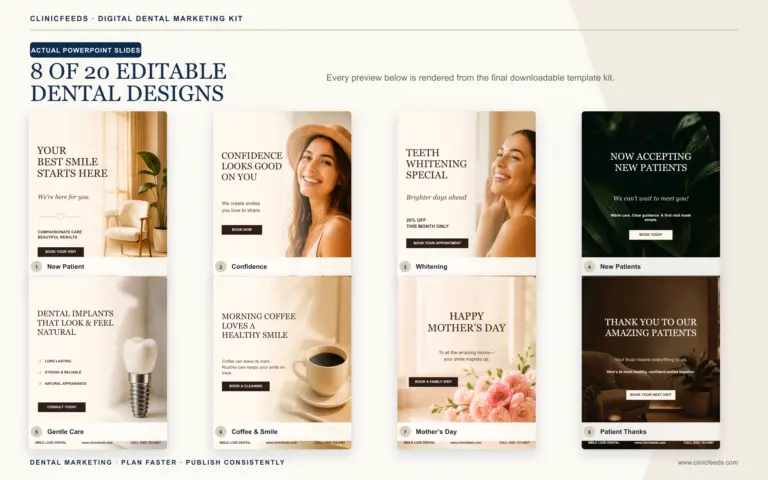
The campaign can use one approved core message without forcing one file into every platform. ClinicFeeds’ current dental kits use 4:5 Feed, 9:16 Story/Reels and 2:3 Pinterest formats.
- 4:5 Instagram or Facebook feed: use one clear headline, a short supporting point and a caption that explains the next step.
- 9:16 Story or Reel frame: divide a topic into two or three readable frames, then place the action on the final frame. Keep interface-safe space around text.
- 2:3 Pinterest Pin: use a searchable, specific headline such as “7 Questions to Ask at a Dental Implant Consultation” and link to the complete resource page.
Do not paste a paragraph into the image. The design should help a person decide whether to read; the caption or linked page can carry the detail.
Approval Workflow for a Small Dental Team
Batch the work once per week. A practical 30-minute review meeting can prevent last-minute rewrites:
- Campaign owner: confirms the upcoming three or four posts, dates and destinations.
- Clinical reviewer: flags unsupported claims, missing qualifications, inaccurate timelines and language that could be read as an individual recommendation.
- Office manager or treatment coordinator: checks consultation availability, fee language, phone routing and what the front desk will say when someone calls.
- Publisher: verifies image permission, spelling, alt text, platform size, UTM link and final approval status.
Use a status column in the content plan: Draft, Clinical Review, Operational Review, Approved, Scheduled and Published. “Designed” is not the same as “approved.”
How to Track Consultation Intent Without Chasing Vanity Metrics
Reach and likes can help diagnose distribution, but they do not show whether the booking path worked. Review the campaign at three levels.
Content signals
- qualified landing-page visits from each post;
- saves on education and question-list posts;
- outbound link clicks or Story link taps;
- relevant, non-clinical questions that reveal information gaps.
Conversion signals
- consultation-form starts;
- completed consultation requests;
- phone calls attributed to the campaign;
- consultations scheduled and attended.
Operational signals
- time from enquiry to first response;
- percentage of requests the practice could not reach;
- common questions not answered on the landing page;
- posts delayed because clinical or operational approval was missing.
Use a consistent source field in the form and appointment notes, such as “Instagram — Implant Campaign.” Do not ask people to put medical histories, radiographs or detailed symptoms in a public comment or an unsecured social direct message.
US and Canadian Review Notes Before Publishing
This guide is a marketing workflow, not legal or clinical advice. Requirements vary by state, province, regulator and practice circumstances. The final content should be reviewed against the rules that apply to the practice.
- Truthful, supportable claims: the US Federal Trade Commission states that advertising must be truthful and not misleading, and objective health-related claims require appropriate substantiation. Review the whole impression created by words and images, not only the headline.
- Patient privacy: the ADA advises practices not to post a patient’s name, testimonial, photograph, radiograph or other patient information without the appropriate written consent, authorization, waiver and release. A public reply should not confirm that a reviewer is a patient.
- Final professional approval: use a designated reviewer and retain final approval even when a team member or outside agency manages the account.
- Canadian provincial rules: Canadian practices should review their provincial dental regulator’s advertising, privacy and professional social-media requirements. For example, the Royal College of Dental Surgeons of Ontario treats online advertising and professional social-media conduct as part of a dentist’s professional obligations.
- Titles and specialist language: do not call a dentist an implant specialist, or imply specialist status, unless the designation is permitted and accurately disclosed in the relevant jurisdiction.
- Offers, fees and financing: confirm current terms, eligibility, limitations and required disclosures before publication. Avoid guarantees about insurance coverage, financing approval, candidacy or outcomes.
Useful primary references include the FTC Health Products Compliance Guidance, the ADA’s Social Media Policies for Dentists and Marketing and Advertising guidance, plus the RCDSO’s professional social-media guidance and advertising guidelines. Practices outside Ontario should use their own provincial regulator’s requirements.
Use a Ready-to-Edit Dental Implant Campaign System
The Dental Implant Consultation Social Media Campaign Kit is built for practices that want the campaign assets and planning file prepared before the weekly approval meeting. It includes 60 editable PowerPoint pages across 20 implant consultation themes: 20 layouts in 4:5 Feed format, 20 in 9:16 Story/Reels format and 20 in 2:3 Pinterest format. The download also includes an Excel content plan with captions, calls to action and image prompts, plus a User Guide and License PDF.
Use the kit as a starting system, then replace the clinic details, images, wording and calls to action. The practice remains responsible for clinical accuracy, image permissions, service availability and local advertising compliance.
View the Dental Implant Consultation Social Media Campaign Kit
For a broader workflow beyond this single campaign, visit the Dental Social Media Content System.
Frequently Asked Questions
How long should a dental implant consultation campaign run?
Four weeks is a practical starting point for 14 posts at three or four posts per week. A practice that publishes twice weekly can use the same order over seven weeks. Keep the education-to-consultation sequence intact rather than forcing the campaign into a shorter window.
Should every post ask patients to book?
No. Early posts can invite readers to learn, save a checklist or review what happens at a consultation. Use a direct consultation request when the topic reflects higher intent, such as what to expect, timing, fees or the final campaign post.
Can the same implant campaign be used on Instagram and Pinterest?
The same approved topic can be adapted, but the presentation should fit the platform. A 4:5 feed post can introduce one point, a 9:16 Story can divide the explanation into frames, and a 2:3 Pinterest Pin can use a specific searchable headline that links to a complete web resource.
Who should approve dental implant social media content?
A clinician should review treatment, candidacy, recovery and outcome language. The office manager or treatment coordinator should verify booking, fee and availability details. A designated final publisher should confirm consent, links and the approved version before scheduling.
What should a dental implant campaign measure?
Track qualified landing-page visits, link clicks, form starts, completed consultation requests, attributed phone calls, scheduled consultations and attended consultations. Also monitor response time and common unanswered questions. Likes alone do not show whether the consultation path worked.
Can a practice discuss a patient’s implant question in Instagram comments or direct messages?
Do not request or discuss patient-specific health information in public comments. Practices should use their approved secure communication and privacy procedures for individual clinical questions. A general reply can direct the person to the practice’s normal contact route without confirming a patient relationship.
What should a dental implant social media campaign include?
A useful campaign includes a defined audience, one primary consultation route, a sequenced topic plan, platform-specific formats, clinical and operational reviewers, response ownership, campaign-tagged links and meaningful conversion metrics. The practice should use its actual services, consultation process and booking route rather than copying generic promises.
Should dental implant campaign posts mention fees or financing?
Only when the information is current, complete and permitted in the practice’s jurisdiction. Confirm eligibility, limitations and required disclosures, avoid implying financing approval or insurance coverage, and direct readers to a maintained page or approved office contact route for practice-specific details.
Sources and Review Notes
The following primary resources support the advertising, privacy and professional-review boundaries in this article. They do not replace the state, provincial or professional requirements applicable to an individual practice.
- Federal Trade Commission: Health Products Compliance Guidance
- American Dental Association: Social Media Policies for Dentists
- American Dental Association: Marketing and Advertising
- US Department of Health and Human Services: HIPAA Privacy Rule
- Royal College of Dental Surgeons of Ontario: Use of Social Media
- Royal College of Dental Surgeons of Ontario: Advertising Guidelines
- Office of the Privacy Commissioner of Canada: Privacy Laws in Canada
US practices should also review their state dental board and applicable privacy requirements. Canadian practices should review the advertising, privacy and professional standards of their own provincial regulator.
Last reviewed: August 1, 2026. This article is for dental-practice marketing and content planning. It does not provide clinical or legal advice.