
Quick Answer
Useful dental implant patient education content starts with questions prospective patients already ask: what an implant is, what happens at a consultation, why timelines may vary and which details require an individual assessment. The 20 dental implant patient education topics below turn those questions into review-ready briefs with one teaching point, a safe boundary, a suggested format, a next step and an assigned reviewer.
This guide is for dental practice owners, treatment coordinators and marketing teams in the United States and Canada. It supports general education on Instagram, Facebook and Pinterest; it does not diagnose a reader, determine candidacy or replace a dentist’s individual assessment.
Use front-desk and consultation-question logs as input, after removing names, appointment details, health information and any combination of facts that could identify a person. Preserve the question—not the patient’s story.
Patients rarely ask for “content.” They ask whether an implant is different from a bridge, what happens at a consultation, how long treatment may take, or what they should bring to an appointment. Those questions can become useful posts—but only after the practice separates general education from individual advice.
This guide is intentionally different from a general bank of dental implant social media post ideas. That resource helps teams choose topics. This one teaches a repeatable question-to-brief workflow, then applies it to 20 real questions with a safe scope, facts to verify, format, next step and review guardrail.
Start With the Question, Not the Template
A polished graphic can still be unhelpful if it answers the wrong question or sends readers to a generic home page. Before designing, capture the language people actually use. Useful sources inside a practice include:
- questions recorded by the front desk after new-patient calls;
- topics the treatment coordinator repeats during implant consultations;
- non-identifying questions submitted through the website;
- common misunderstandings the dentist corrects during treatment discussions;
- search terms that lead people to the implant service page;
- general questions in social comments that can be answered without confirming a patient relationship.
Remove names, appointment details, images, health histories and any combination of facts that could identify a person. The content brief should preserve the question, not the patient’s story.
A Practical Question-to-Content Brief
Use one short brief for every post. A spreadsheet row is enough; the team does not need another complicated content tool.
- Question in plain language: write it as a prospective patient might ask it.
- One useful answer: decide the single point the post can explain accurately.
- Safe boundary: state what the post cannot determine for an individual.
- Clinical facts to verify: assign claims, definitions and treatment language to a dentist or appropriate clinical reviewer.
- Practice details to verify: assign appointment steps, fees, availability and communication routes to the office manager or treatment coordinator.
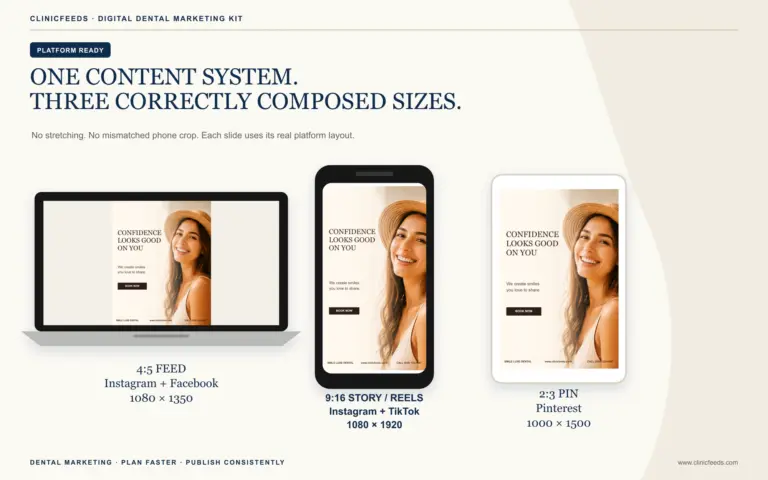
- Format: choose the appropriate 4:5 Feed, 9:16 Story/Reels or 2:3 Pinterest size based on how the information should be consumed.
- CTA and destination: choose the next useful page or approved contact route.
- Final review: confirm claims, privacy, image permission, link, alt text and current practice information.
The brief prevents a common failure: a marketer drafts a broad promise, the dentist edits it late, and the final post no longer matches the design or landing page.
20 Dental Implant Patient Questions to Turn Into Content
The entries below are content briefs, not patient-facing diagnoses. Adapt them to the services, terminology and consultation process the practice actually uses.
1. “What is a dental implant?”
Safe scope: Give a plain-language overview of the implant, the restoration and the supporting tissues without implying that every missing tooth should be replaced this way. Verify: terminology, the types of restorations your practice discusses and any illustration labels. Best format: a 4:5 anatomy overview or a short 9:16 three-frame explainer. CTA: link to the implant service page for a fuller explanation. Guardrail: avoid “permanent tooth” and other language that implies a guaranteed lifetime.
2. “How is an implant different from a bridge or denture?”
Safe scope: Explain that several replacement approaches exist and that the appropriate discussion depends on individual circumstances and preferences. Verify: balanced comparison points and meaningful limitations—not only the advantages of the service being promoted. Best format: a 2:3 comparison guide for Pinterest or a feed graphic that introduces the comparison and sends readers to a complete page. CTA: “Review questions to ask when comparing missing-tooth options.” Guardrail: do not label one option “best for everyone.”
3. “Am I a candidate for dental implants?”
Safe scope: Describe the kinds of factors a clinician may evaluate, while making clear that a social post cannot determine suitability. Verify: the clinician-approved list of factors and wording around oral and general health. Best format: a 9:16 question-and-answer sequence with the assessment boundary on the final frame. CTA: direct readers to the consultation information page. Guardrail: never use a quiz result such as “three yes answers mean you qualify.”
4. “What happens at an implant consultation?”
Safe scope: Explain the practice’s actual flow, which may include discussion, examination, review of history and records, imaging where appropriate, and consideration of next steps. The American Academy of Implant Dentistry’s consultation overview describes many of these common elements while noting that experiences vary. Verify: exactly what your practice includes and who the patient meets. Best format: a 4:5 “what to expect” post. CTA: link to the consultation page. Guardrail: do not promise a treatment plan or price before the assessment.
5. “What should I bring to the consultation?”
Safe scope: Create a practice-specific preparation checklist: identification, medication information, relevant records or insurance information only where your process requires them. Verify: the front desk’s current intake instructions and secure records-transfer process. Best format: a saveable 2:3 checklist or a 9:16 Story reminder. CTA: “Review our consultation preparation page.” Guardrail: do not ask people to send health histories, radiographs or insurance details through public comments or ordinary social messages.
6. “Why might imaging be needed?”
Safe scope: Explain that a clinician may use appropriate records and imaging to understand anatomy and support planning. Keep the post about purpose, not about reading an image. Verify: which imaging services the practice actually uses and when they may be considered. Best format: an illustrated 4:5 education post. CTA: invite the reader to review what happens during planning. Guardrail: do not publish a patient radiograph without the required authorization, and do not assume cropping a name makes an image non-identifiable.
7. “Why does bone support matter?”
Safe scope: Introduce bone and surrounding tissues as factors a clinician considers when evaluating possible options. Verify: every anatomical or treatment claim with the clinical reviewer. Best format: a simple labelled illustration in 4:5 format, with the detailed explanation in the caption. CTA: send readers to an implant-planning FAQ. Guardrail: do not infer a person’s bone condition from the length of time a tooth has been missing.
8. “Will I need a bone graft?”
Safe scope: Explain that additional procedures may or may not be discussed after an individual evaluation. The post can define the question without predicting the answer. Verify: clinician-approved language and whether the practice provides or refers for the relevant service. Best format: a 9:16 “question / what determines the answer / next step” sequence. CTA: “Bring this question to your consultation.” Guardrail: avoid rules such as “if X happened, you will need Y.”
9. “How long does dental implant treatment take?”
Safe scope: Explain that consultation, planning, treatment, healing and restoration may occur in stages, and timing depends on the individual plan. Verify: which stages your practice handles and any timeline language used on the service page. Best format: a 2:3 journey graphic that labels stages without fixed dates. CTA: link to the consultation page for practice-specific planning. Guardrail: a broad time range can still mislead if the variables behind it are hidden.
10. “Can I have a temporary tooth while treatment is underway?”
Safe scope: Say that provisional options depend on the treatment plan and should be discussed with the dentist. Verify: which options the practice actually offers, who is responsible for each stage and the limits of any examples. Best format: a feed FAQ with a short caption rather than a detailed procedural graphic. CTA: direct readers to a secure consultation request. Guardrail: do not imply immediate placement, immediate loading or a same-day restoration is suitable or available in every case.
11. “Does getting a dental implant hurt?”
Safe scope: Acknowledge the concern and explain that comfort planning, the procedure and recovery experience vary; the treating team should discuss what applies to the individual. Verify: the practice’s actual comfort and aftercare process. Best format: a calm 4:5 FAQ led by empathy, not a dramatic before-and-after. CTA: “Ask our team what to expect and how post-treatment questions are handled.” Guardrail: avoid “painless,” “pain-free” or a fixed recovery promise.
12. “What happens during healing?”
Safe scope: Describe healing as a monitored stage and encourage people to follow their own clinician’s instructions. Verify: which follow-up points the practice routinely explains and the approved route for urgent or unexpected concerns. Best format: a 9:16 sequence that distinguishes general education from patient-specific instructions. CTA: link to the practice’s treatment-journey page, not a generic social reply. Guardrail: do not publish one schedule as if it applies to every patient.
13. “How much does a dental implant cost?”
Safe scope: Explain what the practice can responsibly say about estimates: the total may depend on findings, the treatment plan, included components and any additional care. Verify: current fees, what an advertised figure includes, consultation charges and required local disclosures. Best format: a concise feed FAQ that links to a detailed fees page. CTA: “Contact the practice for current, case-specific information after assessment.” Guardrail: do not present a starting price as a complete treatment total.
14. “Does insurance cover dental implants?”
Safe scope: Describe how the office handles benefit questions without promising that a plan will pay. Coverage and limitations vary. Verify: whether the practice verifies benefits, submits estimates or provides documentation, and how staff explain that process. Best format: a short 4:5 administrative FAQ. CTA: send readers to the office’s insurance information page or phone route. Guardrail: never use “covered by insurance” unless the statement is accurate, qualified and current for the circumstances described.
15. “Do you offer payment or financing options?”
Safe scope: State only the payment arrangements or third-party options the practice currently offers. Verify: eligibility, provider name, terms, approval requirements, disclosures and the destination link. Best format: a short-lived Story FAQ supported by a maintained web page; remove or update any Highlight, saved asset or scheduled reuse when the terms change. CTA: “Review current options and eligibility information.” Guardrail: do not imply approval is guaranteed or place essential limitations only in tiny text.
16. “How long do dental implants last?”
Safe scope: Reframe the question around variables, maintenance and the difference between components rather than offering a lifetime number. Verify: claims against reliable evidence and have the clinician approve every qualification. Best format: a 2:3 “factors that matter” education post. CTA: invite readers to learn about ongoing care. Guardrail: patient testimonials or individual examples do not substantiate a universal longevity claim.
17. “How do I care for an implant-supported restoration?”
Safe scope: Explain that home care and professional follow-up remain important, while individual instructions depend on the restoration and patient. Verify: practice-approved care language with a dentist or hygienist. Best format: a saveable 4:5 or 2:3 checklist. CTA: link to a general maintenance page and remind existing patients to follow their own instructions. Guardrail: do not replace individualized aftercare with a generic social checklist.
18. “Does smoking or vaping affect implant treatment?”
Safe scope: Explain that tobacco or nicotine use is relevant information to discuss during assessment and treatment planning; avoid diagnosing risk in a caption. Verify: the clinical wording, evidence source and the practice’s support or referral process. Best format: a clinician-reviewed feed post with a link to a fuller evidence-based resource. CTA: “Tell your dentist about current tobacco or nicotine use when discussing treatment.” Guardrail: do not use fear-based certainty or imply one post can estimate an individual outcome.
19. “Can implants replace more than one tooth?”
Safe scope: Introduce that implant-supported treatment can involve different restorative configurations, which require individual planning. Verify: the services and terminology used by the practice, plus any referral relationships. Best format: an illustrated 4:5 overview with a caption that keeps options general. CTA: link to the relevant service section or consultation page. Guardrail: do not use an illustration to imply a specific configuration is suitable for the viewer.
20. “What questions should I ask at an implant consultation?”
Safe scope: Offer a practical list about alternatives, stages, individual risks and benefits, the clinician’s training and experience, aftercare, total estimated costs and who to contact with concerns. Verify: the list with the clinical and administrative teams. Best format: a 2:3 Pinterest checklist and a 9:16 Story sequence that link to the complete page. CTA: “Save the checklist, then review our consultation process.” Guardrail: keep the post educational; it should support an informed conversation, not replace one.
Turn One Approved Brief Into Three Useful Formats
Once the facts are approved, adapt the presentation rather than rewriting the clinical message from scratch.
- 4:5 Feed: lead with the exact question, answer one point on the graphic, and use the caption for context and the next step.
- 9:16 Story/Reels: use a three-frame rhythm—question, what the answer depends on, where to learn or ask more.
- 2:3 Pinterest: use a specific searchable title and link to a complete, maintained web resource. Checklists and consultation questions fit this format particularly well.
Do not force a paragraph onto the image. The graphic earns attention; the caption and destination page carry the complete explanation. For platform-ready wording, use the separate dental implant Instagram captions guide.
Approval Workflow: Clinical Facts and Office Facts Need Different Owners
A useful post can fail in two different ways. The clinical description may be inaccurate, or the practice information may be out of date. Review both.
- Content owner: records the patient question and drafts the one-point brief without identifying details.
- Clinical reviewer: verifies definitions, candidacy boundaries, risks, healing, treatment stages and implied outcome claims.
- Operational reviewer: checks what the consultation includes, current availability, fees, benefit-verification process, financing language and contact route.
- Privacy and asset check: confirms permission or licensing for every photo, testimonial, radiograph and illustration.
- Final publisher: checks the approved version, platform size, alt text, destination, UTM link and review date.
Add an “information checked on” date to briefs containing fees, financing, availability or office procedures. Evergreen clinical education still needs review when the linked page or practice service changes.
Claims and Privacy Guardrails for US and Canadian Practices
This article is a content workflow, not legal or clinical advice. Apply the rules of the state, province, dental regulator and privacy framework that govern the practice.
For US advertising, the FTC Health Products Compliance Guidance says advertising must be truthful and not misleading, and objective health claims need adequate substantiation. Review the net impression created by the headline, photograph, testimonial and layout—not only whether each sentence seems technically defensible.
US practices subject to HIPAA should follow their documented privacy and authorization procedures and review the HHS HIPAA Privacy Rule materials. A patient photo, name, radiograph, testimonial or combination of details can identify a person. Obtain the appropriate written authorization before marketing use, and do not confirm a patient relationship in a public reply.
Canadian requirements vary by province. Ontario practices, for example, should review the Royal College of Dental Surgeons of Ontario’s professional social-media guidance and advertising guidelines; practices elsewhere should use their own provincial regulator and applicable privacy rules. The Office of the Privacy Commissioner of Canada maintains an overview of federal, provincial and sector-specific privacy laws. Avoid unsupported superiority, specialist, outcome, urgency and price claims.
The AAID article What to Expect at Your Initial Dental Implant Consultation is a useful reference for common consultation questions, but the published post must describe the ClinicFeeds customer’s real process rather than presenting another organization’s overview as a guarantee.
Connect Education to a Consultation Path
Patient education should not end with “follow for more tips.” Match the CTA to what the question signals:
- Early education: read the service page or save the comparison.
- Planning question: review what happens at a consultation.
- Administrative question: visit the maintained fees, insurance or payment page.
- High-intent question: request a consultation or call the practice through the approved route.
For a complete sequence, place selected briefs into the 14-post dental implant consultation campaign plan. Track campaign-tagged implant landing-page visits, form starts, completed requests, attributed calls, scheduled consultations and attendance—not likes alone.
For a month-by-month operating schedule rather than another topic list, use the 30-day dental implant social media content calendar to assign production, approval, reuse, response and reporting work.
Use a Ready-to-Edit Implant Education System
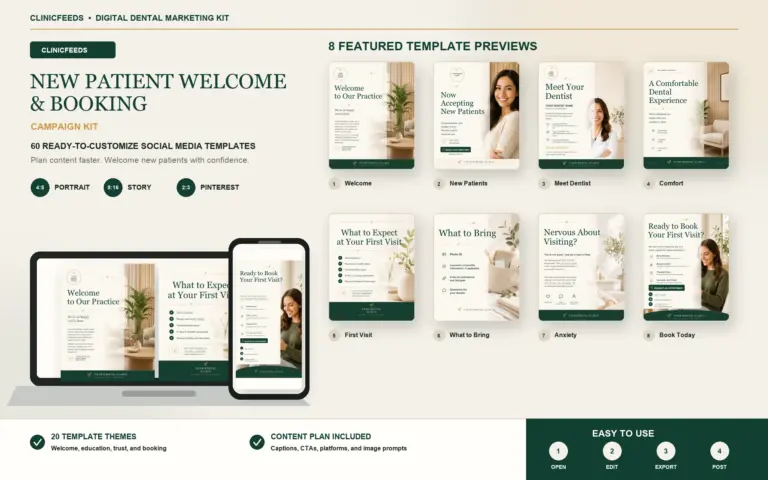
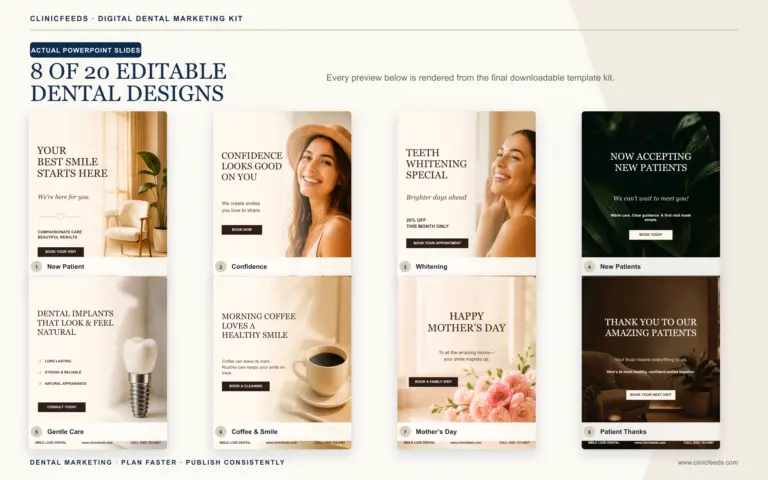
The Dental Implant Consultation Social Media Campaign Kit provides a prepared design and planning system for a 20-theme implant consultation campaign. Several briefs above align directly with included themes; other questions can be developed by adapting an editable layout. Review the product page for the exact theme list.
The kit includes 60 editable PowerPoint pages: 20 layouts in 4:5 Feed format, 20 in 9:16 Story/Reels format and 20 in 2:3 Pinterest format. The ZIP also includes an Excel content plan with captions, calls to action and image prompts, plus a User Guide and License PDF.
Use the files to shorten production time, then customize the clinic details, images, wording and CTAs in PowerPoint. The practice is still responsible for clinical accuracy, service availability, image permission, privacy and local advertising compliance.
View the Dental Implant Consultation Social Media Campaign Kit
For broader education topics beyond implant consultations, review dental patient education post ideas or build the full workflow through the Dental Social Media Content System.
Frequently Asked Questions
What makes a dental implant education post useful?
It answers one real question in plain language, states what requires an individual assessment, and gives the reader a relevant next step. It also matches the practice’s actual services and sends readers to a maintained page rather than a generic home page.
Can a front-desk team member write implant patient education posts?
A front-desk or marketing team member can capture questions and prepare a brief. A qualified clinical reviewer should approve treatment, candidacy, healing, risk and outcome language. An operational reviewer should separately confirm appointment, fee, availability and insurance-process details.
Can a practice answer “Am I a candidate?” in Instagram comments?
Do not determine candidacy in a public comment. Give a general response explaining that suitability requires an individual assessment, then direct the person to the practice’s approved consultation route without requesting health information on the platform.
Can patient photos or radiographs be used in education posts?
Use them only when the practice has the appropriate authorization and has completed its privacy and advertising review. Cropping a name may not remove all identifying information. Licensed illustrations or properly staged images are often simpler for general education.
How often should dental implant education posts be published?
There is no universal frequency. A practice can place one or two implant education posts per week within a broader content calendar, or use a short sequenced campaign. Choose a pace the team can review, publish and support with accurate landing pages and timely enquiry handling.
Where should a dental implant education post link?
Link to the page that answers the next question: an implant overview, consultation process, comparison, fees information, question checklist or secure consultation request. Avoid sending every post to the home page, and do not collect patient-specific health information through public comments.
What dental implant questions make useful patient education content?
Start with questions the practice repeatedly receives before a consultation, such as what an implant is, how the consultation works, why imaging may be discussed, how treatment timelines are planned and what information the patient should bring. Choose questions the practice can answer accurately without assessing an individual through social media.
How should one patient question be adapted for Instagram Feed, Stories and Pinterest?
Keep the approved answer and clinical boundary consistent. Use a 4:5 Feed post to introduce the main point, a 9:16 Story sequence to divide it into short steps and a 2:3 Pinterest Pin to present a searchable question that links to a complete practice resource. Do not shorten the copy in a way that removes an important qualification.
Sources and Review Notes
- Federal Trade Commission: Health Products Compliance Guidance
- HHS: HIPAA Privacy Rule
- HHS Office for Civil Rights: HIPAA Privacy and Marketing
- RCDSO: Use of Social Media
- RCDSO: Advertising Guidelines
- Office of the Privacy Commissioner of Canada: Privacy Laws in Canada
- American Academy of Implant Dentistry: What to Expect at an Initial Consultation
Last reviewed: August 1, 2026. This resource supports dental-practice content planning and does not provide clinical or legal advice.