
Quick Answer
Useful dental implant social media post ideas answer one real pre-consultation question at a time. A practice can explain missing-tooth options, show what happens during a consultation, clarify planning steps, introduce the implant team and invite an appropriate next action—without diagnosing a person or promising a result online.
This guide is written for dental practice owners, office managers, treatment coordinators and in-house marketing teams in the United States and Canada. These social media posts for dental implants turn recurring consultation questions into practical dental implant content ideas, not patient-specific clinical advice or ready-made claims. Adapt every brief to the practice’s actual services, approved destination page, workflow and local advertising rules.
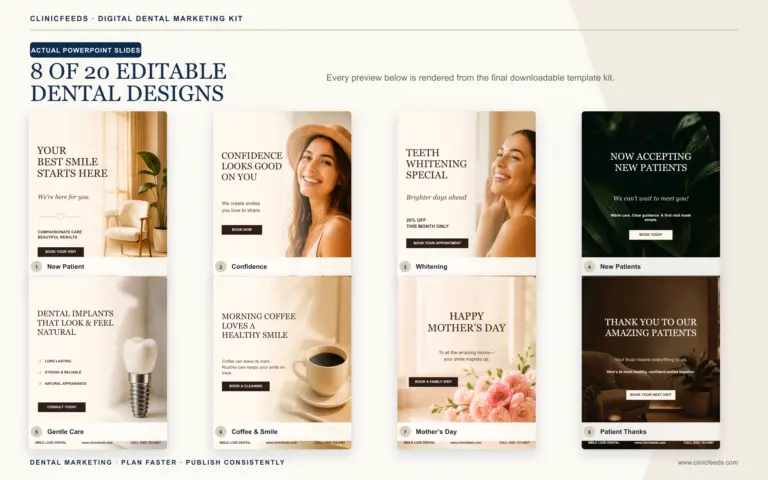
If the topics are already approved and the remaining problem is production, review the editable dental implant social media templates included in the ClinicFeeds consultation campaign kit.
What Should a Dental Practice Post About Dental Implants?
A balanced implant content plan should help a prospective patient understand the consultation process before it asks them to book. Useful categories include:
- Missing-tooth and treatment-option education
- Consultation preparation and questions to bring
- High-level treatment-planning steps
- Recovery and maintenance questions to discuss with the dentist
- Verifiable team experience and practice workflow
- Patient stories used only with appropriate authorization
- Clear, low-pressure consultation prompts
Start with the questions your front desk, treatment coordinator and dentist already answer. If the same question appears repeatedly, it is usually a stronger post topic than a generic “restore your smile” graphic.
For a broader mix of everyday services, trust content and operational reminders, use the companion guide to general dental social media post ideas.
The American Academy of Implant Dentistry consultation overview describes broad stages such as an initial conversation, examination, imaging where appropriate, planning and time for questions. Those stages provide a useful editorial framework, but publish only the steps that match your practice.
30 Dental Implant Social Media Post Ideas
Missing-Tooth Awareness and Treatment Options
- “I am missing a tooth. What should I do next?” Focus on requesting an evaluation rather than immediately promoting one treatment. Acknowledge that replacement options and recommendations depend on an individual assessment.
- What is a dental implant? Use a simple, high-level diagram to identify the implant, connecting component and replacement tooth. Keep surgical detail out of the first post and avoid suggesting that every missing tooth should be treated the same way.
- Bridge, removable denture or dental implant? Present factors a dentist may discuss—number and location of missing teeth, oral health, bone support, treatment sequence, maintenance and patient preferences—rather than declaring a universal winner.
- One missing tooth versus several missing teeth. Explain that planning may differ depending on how many teeth are missing and where they are located. The useful message is that treatment planning is individualized.
- Why a social media photo cannot confirm implant suitability. Clarify that a photograph or direct message cannot replace a health history, examination and any imaging the dentist considers necessary.
Implant Consultation Preparation
- What happens at a dental implant consultation? Show the practice’s real sequence: conversation, records or history review, examination, possible imaging, discussion of options and time for questions.
- Meet the implant consultation team. Introduce the dentist, treatment coordinator and other people a prospective patient may meet. Explain each role in plain language.
- What information should a patient bring? Create a checklist based on the practice’s actual intake process, such as a medication list, relevant records and questions the patient wants to discuss.
- Why imaging may be discussed. Explain why the dentist may need information beyond an ordinary photograph when assessing anatomy and considering possible treatment.
- Questions to bring to an implant consultation. Build a saveable list around provider training, available options, treatment stages, recovery, risks, benefits and maintenance. The AAID patient question worksheet can inform the editorial scope, but use the practice’s own wording.
Treatment Planning and Process
- The dental implant treatment journey at a glance. Show the general pathway from consultation to planning, treatment, follow-up and ongoing care. Label it as an overview and state that individual sequences vary.
- Why implant treatment timelines vary. Explain the categories that may affect scheduling and sequencing instead of advertising one completion time for everyone.
- Why bone support is assessed. Introduce bone support as one part of planning without telling readers whether they personally have enough bone.
- “Will I need a bone graft?” Frame this as a question for the consultation. Explain what the practice evaluates before discussing whether an additional procedure may be recommended.
- What happens to appearance during treatment? Encourage prospective patients to ask about temporary-tooth options and the sequence used by the practice. Do not promise a particular temporary solution before assessment.
Cost, Recovery and Maintenance Questions
- What goes into a personalized implant estimate? Explain why a headline price may not represent an individual plan. Mention only factors that apply to the practice’s real estimating process.
- Insurance and financing questions to ask. Create a checklist covering estimates, plan limitations, payment timing and verified financing arrangements rather than promising coverage.
- Planning for recovery. Focus on questions a patient may want to discuss: time away from work, eating, follow-up visits, transportation and whom to contact with concerns.
- Dental implants still require ongoing care. Correct the idea that an implant can be ignored after treatment. Let the dentist approve any specific maintenance recommendations.
- Smoking and the planning conversation. Explain why patients should accurately disclose smoking or nicotine use during consultation. Keep the tone factual and non-judgmental.
Trust-Building Content
- The dentist’s implant education and training. Use exact, verifiable credential names, relevant continuing education and accurately described experience. Avoid “best implant dentist” claims.
- Behind the scenes of treatment planning. Show a non-patient-specific planning meeting, sanitized workspace or demonstration model. Check screens, scans and paperwork for identifying information.
- The technology the practice actually uses. Choose one workflow or piece of equipment and explain its role in understandable terms. Avoid “guarantees precision” or “eliminates risk.”
- A patient story with context. With appropriate authorization, describe the question the patient brought to the practice and how the team supported the consultation process. Do not turn one person’s experience into a promise for everyone.
- Before-and-after images with useful explanation. Add context, obtain authorization for the specific use and avoid implying that another patient will receive the same result.
Consultation Conversion Posts
- Dental implant myth versus fact. Choose one misconception the dentist regularly hears. Keep the correction narrow, evidence-based and clinically reviewed.
- Five implant questions from this month. Ask the treatment coordinator to identify recurring questions without referencing individual patients. Turn the answers into a monthly roundup.
- “What would you like us to explain next?” Use a Story question box or poll for general topics such as consultations, treatment stages or maintenance. Do not invite personal health details in comments or ordinary direct messages.
- Dental implant consultation preparation checklist. Build a saveable checklist around the practice’s real scheduling, intake and records process.
- A direct consultation invitation. After several educational posts, explain who the consultation is designed for, what the person can expect and how to contact the practice. Use one next action.
How to Adapt One Implant Topic for Each Platform
The core topic can be reused, but the layout and copy should be adapted rather than stretched or pasted unchanged.
| Platform | Practical treatment |
|---|---|
| Instagram Feed | Use a 4:5 graphic or short carousel. Put one clear question on the opening slide and finish with one next step. |
| Instagram Stories/Reels | Reframe the topic vertically in 9:16. Use three short frames, a dentist or coordinator explanation, or a general question sticker. |
| Check the 4:5 crop, add slightly more context in the post copy and link to the relevant practice page where appropriate. | |
| Turn the topic into a 2:3 evergreen educational Pin with a clear title and a destination page that continues the subject. |
For exact dimensions, safe zones and repurposing rules, use the ClinicFeeds guide to dental social media post sizes and the workflow for repurposing dental content across Instagram, Facebook and Pinterest.
When the visual topic is approved but the copy still needs work, adapt these dental implant Instagram captions to the practice’s real consultation process and review requirements.
A Practical Four-Week Implant Posting Rhythm
A multi-service dental practice does not need to promote implants every day. A short sequence can move from recognition to understanding, trust and an appropriate consultation invitation.
- Week 1 — Recognize the question: missing-tooth options, what an implant is, and treatment-option consultation factors.
- Week 2 — Make the consultation familiar: what happens, what information to bring, and questions to ask.
- Week 3 — Explain planning: the general journey, why timelines vary, and why imaging or bone support may be discussed.
- Week 4 — Build trust and invite a next step: team or credential post, clinician-reviewed myth versus fact, preparation checklist, and consultation invitation.
For each week, one 4:5 educational post, one supporting 9:16 Story or Reel and one evergreen 2:3 Pinterest Pin create a coherent campaign without repeating the same asset. Adjust frequency using qualified inquiries, saves, destination-page visits and the team’s real capacity—not a universal posting benchmark.
Use the 30-day dental social media content calendar guide when you need to assign owners, approvals and publishing dates across the full practice schedule.
For a service-specific sequence rather than a general monthly calendar, follow the 14-post dental implant consultation campaign plan from education through appointment requests.
Turn the selected questions into clinically reviewable briefs with the dental implant patient education post workflow, then coordinate production, approvals, Story and Pinterest reuse, replies and reporting with the 30-day dental implant social media content calendar.
Dental Implant Content Review Checklist
- Does the practice actually provide every service mentioned?
- Has a dentist reviewed clinical wording, timelines and suitability statements?
- Does the headline or image imply a result that the body copy cannot support?
- Have unsupported words such as “guaranteed,” “permanent,” “pain-free,” “risk-free” or “best” been removed?
- Are prices, financing terms, insurance statements and availability current?
- Does every patient image, testimonial or case detail have appropriate written authorization?
- Does the authorization cover the specific platform, context and type of use?
- Have screens, schedules, radiographs and documents been checked for identifying information?
- Is the CTA accurate, working and linked to a relevant destination page?
- Has the post been reviewed against applicable state, provincial and professional advertising requirements?
The FTC Health Products Compliance Guidance explains that health-related advertising must be truthful, non-misleading and appropriately substantiated, including claims implied through testimonials or images. The ADA social media guidance for dentists recommends written releases before using patient names, testimonials, photographs or radiographs.
Canadian practices should check their provincial regulator. Ontario’s RCDSO social media guidance emphasizes privacy, professional boundaries and consent that matches the intended context. These sources are editorial references, not substitutes for legal advice or local professional requirements.
Turn the Ideas Into a Ready-to-Edit Implant Campaign
Planning topics is only the first part of the job. The practice still needs to format each post, create platform-specific sizes, write appropriate next steps and keep the campaign visually consistent.
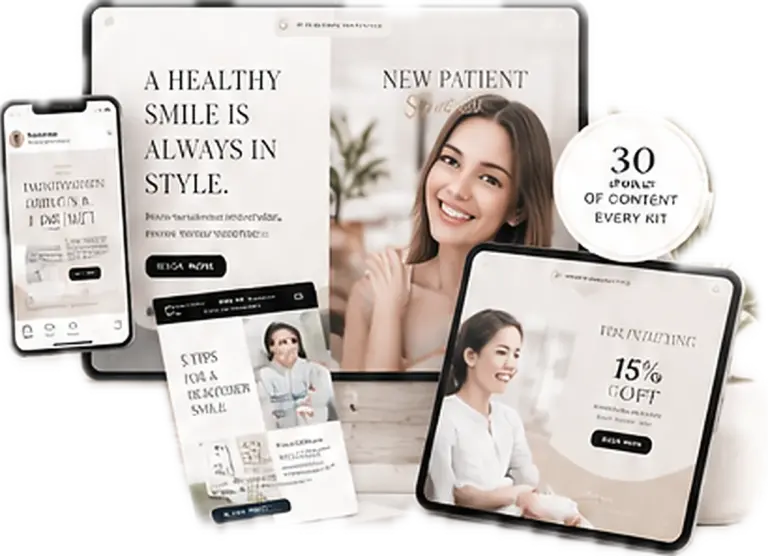
The Dental Implant Consultation Social Media Campaign Kit turns 20 consultation themes into 60 editable PowerPoint pages:
- 20 Instagram Portrait pages in 4:5 format
- 20 Story/Reels pages in 9:16 format
- 20 Pinterest pages in 2:3 format
- An Excel content plan with captions, CTAs and image prompts
- User Guide and License PDFs
Edit the clinic details, colors, wording and sample photography, then have the final content reviewed before publishing. For broader planning, see the Dental Social Media Content System and the guide to dental patient education post ideas.
Frequently Asked Questions
What should a dental practice post about dental implants?
Post content that answers real pre-consultation questions: missing-tooth options, what happens during a consultation, how planning works, why timing varies, what patients can ask about recovery and how to request an assessment. Mix education, trust and next-step posts rather than publishing only promotions.
How often should a dental practice post about implants?
There is no universal frequency. A multi-service practice can begin with one implant-related feed post and one supporting Story each week. During a focused consultation campaign, use a structured three- or four-week sequence and adjust it using qualified inquiries and team capacity.
Can the same dental implant post be used on every platform?
The topic can be reused, but the asset should change. Use 4:5 for feed education, 9:16 for Stories or Reels, check the crop and context before using it on Facebook, and rebuild it in 2:3 for an evergreen Pinterest Pin.
Can a dental practice share implant before-and-after photos?
Potentially, but the practice needs appropriate authorization, must protect patient privacy and should review applicable advertising rules. The wording and imagery should not imply a guaranteed or universally typical result.
Should dental implant posts be reviewed by a dentist?
Yes. A dentist familiar with the practice’s services should review clinical claims, timelines, candidacy language, recovery statements and comparisons before publication. Templates and content ideas are marketing tools, not patient-specific clinical advice.
What is the best CTA for a dental implant post?
Match the CTA to the reader’s stage. Educational posts can invite readers to save the information or learn what a consultation involves. Consultation-ready posts can invite them to call, request an appointment or visit the practice’s implant consultation page. Use one action per post.
What should a dental implant social media post link to?
Link to the most relevant maintained page: an implant overview, consultation-process guide, patient FAQ, current fees or financing information, or an approved consultation request page. Avoid sending every post to the homepage, and do not collect patient-specific health information through public comments or unsecured social messages.
Sources and Review Notes
- American Academy of Implant Dentistry: What to Expect at an Initial Dental Implant Consultation
- AAID: Questions to Ask When Choosing an Implant Dentist
- Federal Trade Commission: Health Products Compliance Guidance
- American Dental Association: Social Media Policies for Dentists
- Royal College of Dental Surgeons of Ontario: Use of Social Media
Last reviewed: July 31, 2026. This article is for dental-practice content planning and does not provide clinical or legal advice.