
This guide is written for private dental practices in the United States and Canada. Use the capacity model below as an operational planning tool, then adapt privacy procedures, advertising review and patient communication to the federal, state, provincial and professional rules that apply to your practice.
Quick Answer
A dental practice does not need one universal posting frequency. A practical starting point is one or two clinic-approved core themes per week; move to three only when the team can customize, review, schedule and monitor them consistently. Count one topic once even when it is exported in three sizes. With 60 themes, one, two or three themes per week can support 60, 30 or 20 weeks before deliberate reuse.
The right dental social media posting frequency is not the highest number your team can publish during one enthusiastic week. It is the highest pace the practice can maintain while keeping every post accurate, useful, approved and connected to a clear next step.
The American Dental Association emphasizes that social media requires ongoing monitoring, regular posting and timely, appropriate responses. That is why a small practice should choose its cadence from actual staff capacity rather than copying a generic “post every day” recommendation.
If your team still needs to decide what belongs in the monthly plan, start with the 30-day dental social media content calendar guide. This article addresses the next question: how much of that plan can your practice reliably produce each week?
There Is No Universal Best Posting Frequency for Dental Practices
A family dental office with one practice manager does not have the same production capacity as a multi-provider clinic with a dedicated marketing coordinator. The sustainable number changes according to:
- who selects the topics;
- who edits the graphics and captions;
- who checks clinical statements, offers and patient information;
- how quickly the final reviewer responds;
- which platforms the practice actually maintains;
- whether someone can monitor comments and messages after publication; and
- how much approved photography and evergreen content is available.
Publishing more frequently is not an improvement if it causes rushed claims, expired promotions, repeated graphics, unanswered messages or skipped privacy checks. A consistent two-theme week can be more useful operationally than an ambitious daily schedule that the team abandons after ten days.
Count Core Themes Before You Count Posts
Dental teams often overestimate their content output because they count every exported size as a separate idea. For planning purposes, separate three units:
| Unit | What It Means | Example |
|---|---|---|
| Core theme | The patient question, campaign message or clinic topic being communicated. | Why gums may bleed during brushing |
| Format asset | A layout composed for a specific canvas ratio. | 4:5 Feed, 9:16 Story and 2:3 Pinterest versions |
| Published placement | The actual post uploaded to a selected clinic channel. | An Instagram Feed post or Pinterest Pin |
One gum-health theme can generate three format assets, but it is still one core topic. The 4:5, 9:16 and 2:3 files are not three unrelated educational messages. Keeping this distinction prevents a practice from believing it has 180 unique ideas when it has 60 themes supplied in 180 separately composed PowerPoint pages.
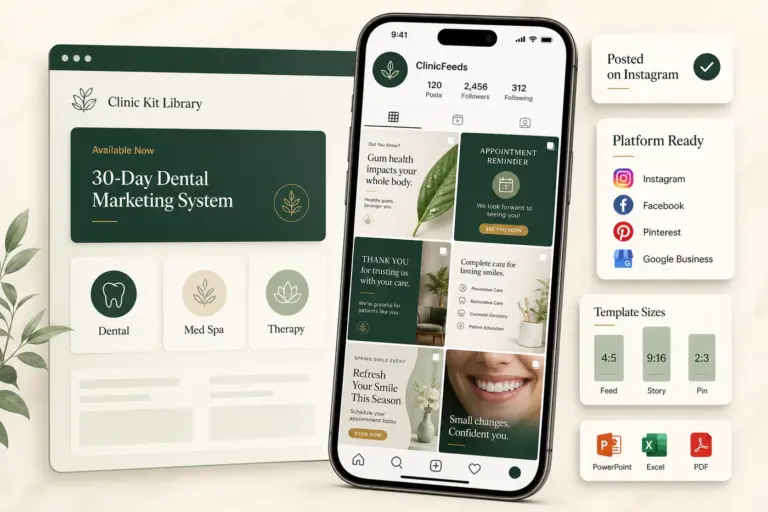
Review the dental social media post-size guide when deciding which format is appropriate for Instagram, Facebook and Pinterest.
Three Capacity-Based Posting Models
The following models are planning options, not platform rules. Select the lowest cadence your team can complete without borrowing time from patient care or bypassing review.
| Core Themes Per Week | Available Format Assets If All Three Sizes Are Prepared | How Long 60 Themes Last | Likely Fit |
|---|---|---|---|
| 1 | Up to 3 | 60 weeks | A small team with no dedicated marketer |
| 2 | Up to 6 | 30 weeks | A practice manager or coordinator with protected production time |
| 3 | Up to 9 | 20 weeks | A team with assigned production, approval and monitoring responsibilities |
The format-assets column shows what is available when every theme is prepared in all three included sizes. It does not mean the practice must publish every asset on every platform.
Model 1: One Core Theme per Week
This is the leanest sustainable model. It can work for an owner-managed office or a clinic where social media is one responsibility among scheduling, billing, patient communication and front-desk work.
A simple weekly cycle could be:
- Select one relevant patient question or clinic priority.
- Customize the matching visual and caption.
- Submit it for clinical and practice review.
- Export only the formats needed for active channels.
- Schedule the post and assign responsibility for replies.
With 60 included themes, this model provides 60 weeks of core topics before the practice needs to intentionally revisit a theme. Publishing the same topic to selected channels does not reduce the library faster.
Model 2: Two Core Themes per Week
Two themes create enough variety for many small practices without requiring daily production. One theme can answer a patient question or support trust; the other can address a current clinic priority such as new-patient orientation, preventive care or a timely reminder.
For example:
- Theme A: an evergreen hygiene or patient-education topic;
- Theme B: a new-patient, service-awareness or clinic communication topic.
At two themes per week, a 60-theme library supports 30 weeks before deliberate reuse. The team can also vary the channel mix instead of forcing every theme onto every platform.
Model 3: Three Core Themes per Week
Three themes per week require more than editable graphics. The practice needs a predictable source of clinic information, a reviewer who responds on time and someone who can monitor published posts.
A balanced three-theme week might include:
- one everyday or trust-building topic;
- one new-patient communication topic; and
- one hygiene or gum-health education topic.
At this pace, 60 themes support 20 weeks. This model is appropriate only when the practice can maintain the workflow without turning every post into a promotion or asking clinical staff to create content during patient-care time.
Calculate Capacity Before Selecting a Schedule
Use the following operational rule:
Sustainable weekly cadence = the lowest of production capacity, review capacity and response capacity.
A team that can edit three themes but approve only one does not have a three-theme capacity. Likewise, a practice that publishes frequently but cannot respond to appointment questions or correct inaccurate information has exceeded its operational capacity.
Before choosing one, two or three themes per week, answer these questions:
- Who owns the calendar? Name one person, not “the front desk.”
- How many themes can the team prepare during protected work time? Do not include time that is routinely interrupted by patients.
- How quickly can the final reviewer respond? Include the waiting period, not only editing minutes.
- Who monitors the published channels? Assign responsibility for questions, comments and inappropriate disclosures.
- Which channels are genuinely active? Prepare only the sizes the practice plans to use.
Run a Four-Week Capacity Test
Do not redesign the entire marketing calendar before testing the workflow. Run the proposed cadence for four weeks and record:
- how many planned themes were completed;
- which step caused delays;
- how often a caption or graphic required correction;
- whether reviewers had enough context to approve the post;
- whether comments and messages were monitored; and
- which topics generated useful profile visits, website actions, calls or appointment inquiries.
Increase the cadence only when the current schedule is completed without rushed review or unresolved audience responses. If the team repeatedly misses its own deadlines, reduce the number of themes before removing the approval step.
Include Review Time in the Publishing Schedule
Content production is not complete when the graphic looks finished. A practical workflow includes separate decisions:
| Stage | Owner | Decision |
|---|---|---|
| Plan | Practice manager or content coordinator | Is this topic relevant to a real clinic priority? |
| Customize | Assigned editor | Are the clinic details, image, caption and call to action correct? |
| Review | Dentist or designated reviewer | Are clinical wording, offers, privacy and advertising details appropriate? |
| Export and schedule | Publisher | Is the correct file being used for each selected channel? |
| Monitor | Account owner | Who will respond or escalate questions after publication? |
One person may perform several roles in a small practice, but the stages should remain separate. A final visual check should not replace clinical, privacy or offer review.
For a workflow that does not depend on filming clinicians or assistants, see how to run dental social media without filming staff.
Use Different Formats Without Tripling the Work
After one theme is approved, adapt it to the channel rather than starting from a blank page. The core facts can remain consistent while the presentation changes:
- 4:5 Feed: a concise educational or campaign message for Instagram and Facebook feeds;
- 9:16 Story or static Reel layout: a shorter message with one immediate action;
- 2:3 Pinterest Pin: a search-oriented headline with a useful destination page.
This approach increases distribution without pretending that one idea is three separate topics. Follow the cross-platform dental content workflow when adapting the message and call to action.
How to Rotate the 60 Bundle Themes
The ClinicFeeds Dental Social Media Template Bundle combines three complete content tracks:
- Smile Luxe: everyday dental communication, education, service awareness, trust, reminders and seasonal content;
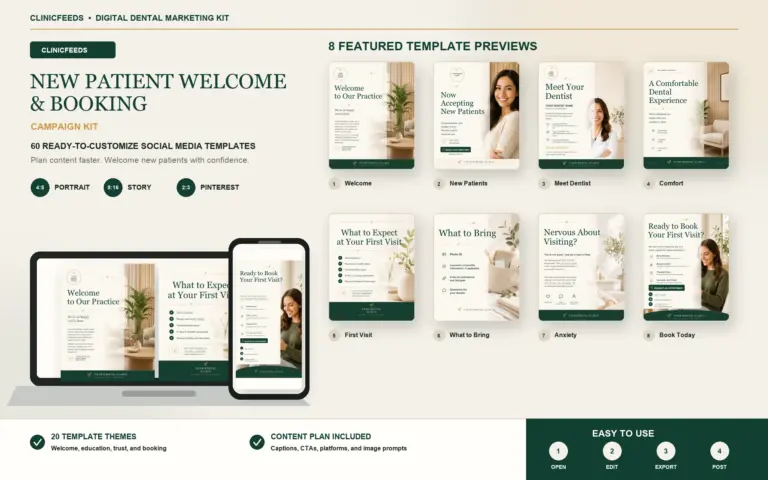
- New Patient Welcome: team introductions, first-visit expectations, practical preparation and appointment invitations; and
- Dental Hygiene & Gum Health: preventive education, hygiene reminders and gum-health awareness.
For one theme per week, rotate between the three tracks. For two themes, pair one evergreen topic with one current clinic priority. For three themes, use one theme from each track when that mix reflects the practice’s actual services and patient communication needs.
Do not force an equal ratio when it does not match the clinic. A practice preparing a new-patient campaign may temporarily use more welcome content. A hygiene-focused month may use more preventive education. The cadence remains stable while the content mix changes.
When Can a Dental Post Be Reused?
Evergreen content can be revisited, but reuse should be deliberate. Before republishing a theme:
- confirm that clinical wording and practice information are still accurate;
- remove expired dates, prices, benefits or promotional terms;
- update the image or visual treatment when appropriate;
- adjust the caption for the current patient question or campaign goal;
- check that the post has not appeared recently on the same channel; and
- send the revised version through the normal approval process.
Reusing a relevant patient question is different from automatically reposting an old graphic. The clinic should treat the earlier post as source material, not as permanently approved content.
When to Increase, Hold or Reduce Posting Frequency
Increase the cadence when:
- the team maintains an approved backlog;
- reviewers consistently respond before the publishing deadline;
- the account owner can monitor questions and comments;
- the practice has enough distinct topics to avoid repetition; and
- additional publishing supports a real campaign or patient communication need.
Hold the cadence when:
- the current schedule is consistent and manageable;
- the content mix supports the practice’s priorities; and
- the team is still learning which topics and channels produce useful actions.
Reduce the cadence when:
- posts routinely bypass review;
- staff are creating content during patient-care time;
- offers or clinic details are frequently corrected after publication;
- comments and messages remain unattended; or
- the feed repeats the same service promotion without new patient value.
Privacy and Professional Review in the United States and Canada
Posting frequency never removes the need for case-by-case review. In the United States, HIPAA and other applicable privacy requirements may affect the use or disclosure of protected health information. HHS explains that uses or disclosures of protected health information for marketing generally require valid written authorization, subject to defined exceptions.
Canadian requirements vary by province and practice context. For example, the Royal College of Dental Surgeons of Ontario states that dentists’ professional, ethical and legal responsibilities extend to online activity, including patient privacy, professional boundaries and advertising. Practices outside Ontario should consult their own provincial regulator and applicable privacy requirements.
Replace demonstration photography with clinic-owned, patient-approved or properly licensed images. Confirm patient authorization, claims, offers, clinic details and calls to action before publishing. This article is an operational planning resource, not legal advice.
Use a Ready-to-Edit Library at the Cadence Your Team Can Maintain
The ClinicFeeds Dental Social Media Template Bundle is a US$59 instant-download system for one dental clinic location. It combines the complete Smile Luxe, New Patient Welcome and Dental Hygiene & Gum Health kits.
- 60 included content themes
- 180 editable PowerPoint pages
- 4:5 Feed, 9:16 Story/Reels and 2:3 Pinterest formats
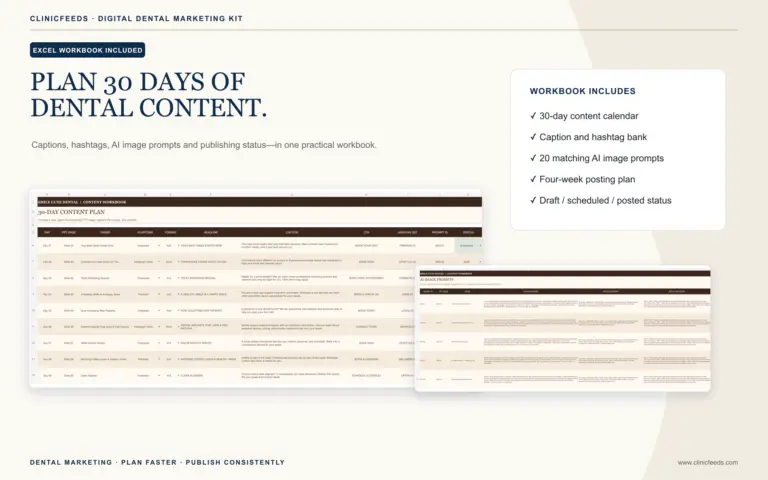
- 9 PPTX files, 3 Excel planners and 6 PDF guides
- Microsoft PowerPoint and Excel; Canva is not required
- One-clinic-location commercial license per purchase
The bundle supplies editable source material and planning tools. It does not publish posts, monitor accounts, provide legal review or replace the practice’s final approval process.
View the Dental Social Media Template Bundle
Frequently Asked Questions
How often should a dental practice post on social media?
There is no universal number. Start with the number of clinic-approved core themes the team can customize, review, publish and monitor every week. One or two themes per week is a practical test for a small practice; move to three only when the workflow remains sustainable.
How often should dentists post on Instagram?
Choose an Instagram cadence from the same capacity model rather than a generic daily target. Begin with one or two approved core themes per week, review performance and workflow after four weeks, and adjust only if the team can maintain quality and respond to audience activity.
Does publishing one theme on three platforms count as three content ideas?
No. It is one core theme adapted into multiple format assets and published placements. Track themes, format files and actual uploads separately so the practice understands its true production capacity.
How long will 60 dental content themes last?
At one core theme per week, 60 themes support 60 weeks. At two per week, they support 30 weeks. At three per week, they support 20 weeks before deliberate reuse. Multi-size exports do not reduce the number of unique themes.
Should every dental social media post promote a service?
No. A practical schedule can mix patient education, new-patient orientation, preventive reminders, trust-building and service awareness. The mix should reflect real practice priorities without turning every post into an offer.
Who should approve dental social media posts?
The practice should designate a reviewer with enough clinical and operational context to check the content. Responsibilities for editing, clinical review, privacy review, scheduling and monitoring should be clear even when one person performs several roles.
Sources and Review Notes
- American Dental Association: Social Media—Introduction
- American Dental Association: Checklist for Engaging in Social Media
- American Dental Association: Social Media Policies for Dentists
- U.S. Department of Health and Human Services: HIPAA and Marketing
- Royal College of Dental Surgeons of Ontario: Use of Social Media
- Meta Help Center: Schedule and Manage Facebook Page Posts
Reviewed August 4, 2026. Platform features, privacy rules and professional advertising requirements can change. Confirm current requirements with the relevant platform, regulator and qualified adviser before publishing.